 ProblemPick
How to Keep a Fitted Sheet From Coming Off
Measure the mattress with every topper and pad in place, then match the fix to the cause. Choose a correctly sized pocket or full-perimeter elastic when the sheet itself is the problem; use corner grippers, cross-style suspenders or a zippered sheet system only when the sheet already fits and still moves.
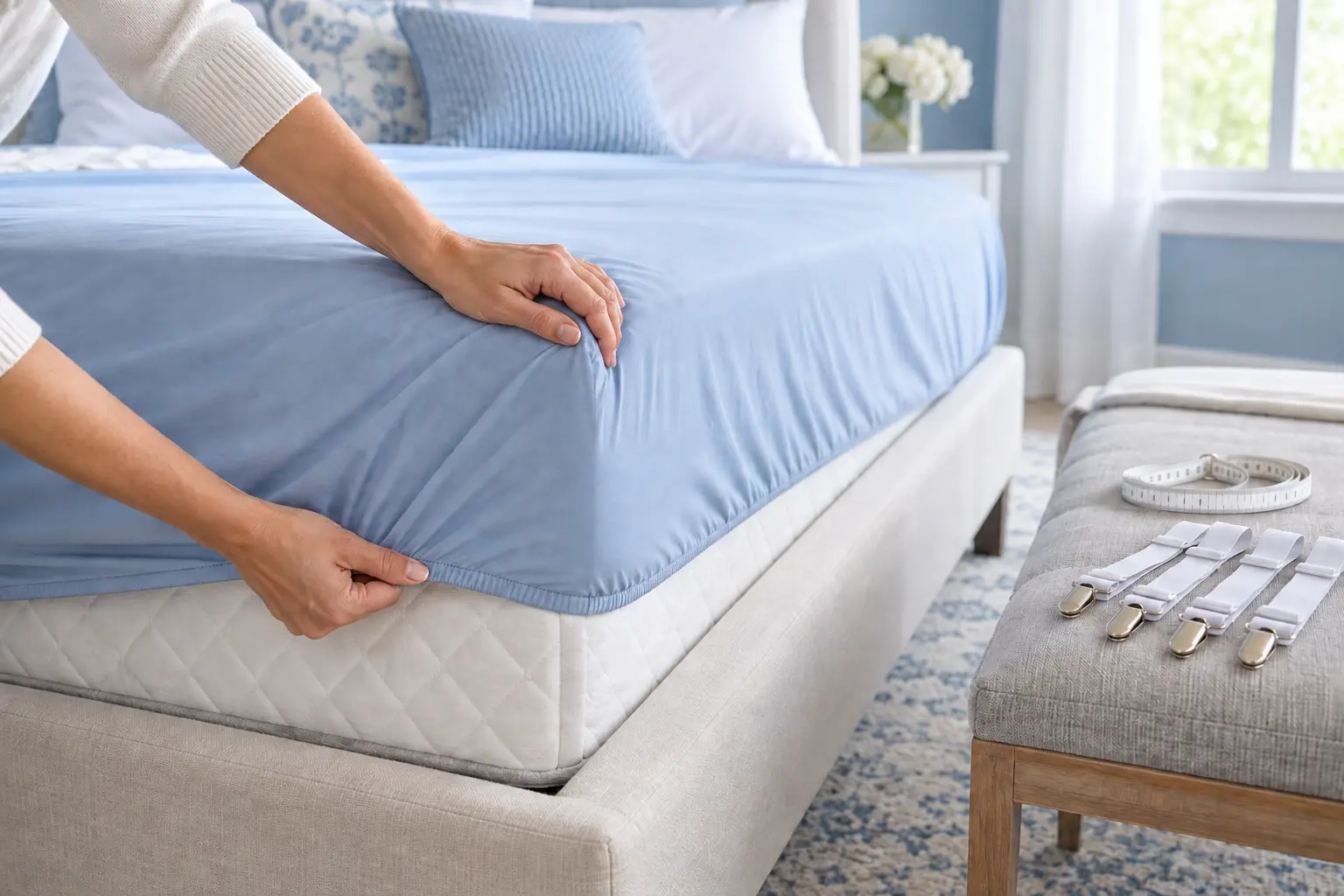
Safe setup: Follow the sheet, accessory, mattress and bed-base instructions. Do not crawl beneath or work around a moving adjustable base. Power it down before fitting any approved strap, keep hardware away from hinges and cables, and ask for help rather than lifting a heavy mattress alone. Do not adapt adult sheet straps for cots or children's beds.
Why does the fitted sheet come off the mattress?
Look at the first corner that releases. If the sheet barely reaches beneath the mattress, the pocket is probably too shallow or the topper was excluded from the size choice. If excess fabric gathers at the sides, the pocket may be too deep or the elastic may have stretched. A sheet that fits when the bed is flat but releases after movement points to the adjustable-base setup rather than size alone.
Remove the sheet and inspect the elastic, corner seams and fabric around any existing clip marks. A damaged seam or permanently relaxed elastic is a replacement problem. Pulling it harder with stronger hardware can transfer the strain to the fabric instead of producing a better fit.
Also check the layers beneath it. A topper or pad that shifts independently can carry the sheet corner with it. Align the layers and confirm that every one is intended for the mattress and base before choosing another product.
How do you measure for a fitted sheet that stays on?
Record the actual measurements, then compare them with each maker's size and pocket-depth range. “Queen,” “king” or “deep pocket” is not a complete fit specification. The sheet should reach beneath the edge without extreme pulling and should not leave a large bag of unused fabric.
Which products can keep a fitted sheet from coming off?
Correct-pocket-depth fitted sheet
Best when the sheet is too shallow, too deep or simply the wrong sizeA fitted sheet works only when its pocket depth and corner shape match the mattress plus every topper or pad. Replacing a visibly mismatched sheet fixes the source of the problem instead of adding hardware to compensate for loose or overstretched fabric.
- Benefits
- Fixes a basic fit mismatch
- Adds no clips beneath the mattress
- Makes routine sheet changes straightforward
- Check before buying
- Measure mattress length, width and total depth with the topper and pad in place. Compare those measurements with the maker's fitted range, not only the bed-size label. Check the wash instructions and whether the listed depth is a maximum or a usable range.
- Possible drawback
- A deeper pocket is not automatically better. Too much unused fabric can gather under a shallow mattress, while a pocket that only just reaches the bottom edge can lift as soon as the bed moves.
Full-perimeter elastic fitted sheet
Best when the size is correct but weak corner-only elastic loses its holdElastic sewn around the entire lower edge distributes grip along the mattress sides instead of asking four short corner sections to do all the work. It is a simple replacement option for a conventional mattress with accessible edges.
- Benefits
- Continuous hold around the lower edge
- No separate accessory to install
- Looks and washes like a normal fitted sheet
- Check before buying
- Confirm the mattress size and depth range, elastic placement, fabric care and return policy. Look at the full product construction rather than assuming every listing described as deep-pocket has elastic around the complete perimeter.
- Possible drawback
- Full elastic cannot correct the wrong pocket depth, a stretched sheet or an incompatible adjustable-bed setup. Strong elastic may also make changes harder on a heavy mattress.
Four-corner sheet grippers
Best for one or two corners that lift on an otherwise well-fitting sheetShort adjustable straps attach across individual sheet corners beneath the mattress. They target the slipping corner and require less routing than a full under-mattress system.
- Benefits
- Targets only the loose corners
- Adjustment is easy to understand
- Uses less strap material than a cross system
- Check before buying
- Check clip shape, strap adjustment range, sheet-fabric compatibility and how much mattress edge must be lifted for installation. Keep clips and adjusters fully below the mattress, away from the sleeping surface and any moving bed hardware.
- Possible drawback
- Clips can mark delicate fabric or release if they are overloaded. Each corner still has to be reached during changes, which can be awkward on a heavy or tightly framed mattress.
Cross-style sheet suspenders
Best when several corners release or an adjustable base creates repeated movementLonger suspenders connect opposite sides or form a cross beneath the mattress, spreading tension across more than one corner. They provide a stronger retrofit than four independent clips when the sheet already fits but moves with the bed.
- Benefits
- Distributes tension across multiple sides
- Offers a broad adjustment range
- Can stabilize several lifting corners
- Check before buying
- Confirm strap length for the mattress dimensions, clip compatibility, access beneath the bed and the adjustable-base maker's instructions. Install only while the bed is stationary and powered down; keep every strap clear of hinges, motors, cables and articulating sections.
- Possible drawback
- Installation is more involved, especially on a heavy mattress or adjustable base. A badly routed strap can interfere with moving parts, and excessive tension can stress the sheet fabric.
Zippered fitted-sheet system
Best for frequent changes when the mattress stays compatible with one fitted baseA zippered system leaves a fitted base around the mattress while the sleeping panel detaches for washing. Because the base remains anchored, it can reduce repeated corner handling and is useful when lifting the mattress is difficult.
- Benefits
- Top panel removes without remaking every corner
- Base stays positioned between changes
- Can simplify access around a heavy mattress
- Check before buying
- Measure carefully and confirm every part of the system, replacement-panel availability, zipper position, wash instructions and compatibility with toppers or adjustable bases. Make sure the zipper pull sits outside the normal sleeping area.
- Possible drawback
- The system costs more than a standard sheet and ties future replacements to compatible panels. Zippers add hardware and may be noticeable if the size or placement is wrong.
ProblemPick compares product types, not current offers. Amazon shows products, prices, ratings, availability and seller terms only after you choose to open a link.
Quick comparison: which sheet-holding option fits the cause?
| Product type | Best use | Main limitation |
|---|---|---|
| Correct-pocket-depth fitted sheet | Best when the sheet is too shallow, too deep or simply the wrong size | A deeper pocket is not automatically better. Too much unused fabric can gather under a shallow mattress, while a pocket that only just reaches the bottom edge can lift as soon as the bed moves. |
| Full-perimeter elastic fitted sheet | Best when the size is correct but weak corner-only elastic loses its hold | Full elastic cannot correct the wrong pocket depth, a stretched sheet or an incompatible adjustable-bed setup. Strong elastic may also make changes harder on a heavy mattress. |
| Four-corner sheet grippers | Best for one or two corners that lift on an otherwise well-fitting sheet | Clips can mark delicate fabric or release if they are overloaded. Each corner still has to be reached during changes, which can be awkward on a heavy or tightly framed mattress. |
| Cross-style sheet suspenders | Best when several corners release or an adjustable base creates repeated movement | Installation is more involved, especially on a heavy mattress or adjustable base. A badly routed strap can interfere with moving parts, and excessive tension can stress the sheet fabric. |
| Zippered fitted-sheet system | Best for frequent changes when the mattress stays compatible with one fitted base | The system costs more than a standard sheet and ties future replacements to compatible panels. Zippers add hardware and may be noticeable if the size or placement is wrong. |
What should you choose for each slipping-sheet problem?
Does the sheet barely reach under the mattress?
Choose the correct pocket depth first. Measure the mattress with the topper and pad installed, then select a sheet whose stated range comfortably includes that total depth.
Does loose fabric gather around a shallow mattress?
A very deep pocket may be the wrong match. Choose a shallower fitted range or a full-perimeter elastic design rather than hiding excess fabric with stronger straps.
Does only one corner pop off?
After confirming the sheet size and seam condition, four-corner grippers provide the most targeted retrofit. Use modest tension and inspect delicate fabric for marks.
Do several corners release when the bed moves?
Compare cross-style suspenders only if the sheet already fits and the base maker allows them. Route every component away from hinges, motors and cables.
Is lifting the mattress during every change the main difficulty?
A compatible zippered system may reduce repeated corner handling. Check the complete system cost and replacement-panel availability before committing to it.
How do you test the new fitted-sheet setup?
For other bedroom problems, compare ways to make a bright bedroom darker or reduce clutter on a small bedside table. Browse the complete Sleep guide collection for more focused product comparisons.
Fitted-sheet buying checklist
Fitted-sheet FAQs
Why does my fitted sheet keep coming off?
The usual causes are a pocket that is too shallow or too deep, stretched elastic, a topper that was not included in the measurement, smooth fabric with little edge grip, or repeated movement from an adjustable base. Identify the cause before adding straps.
How do I measure mattress depth for a fitted sheet?
Measure vertically from the bottom edge of the mattress to the highest point of the sleep surface, including any topper or pad that stays on the bed. Measure more than one corner if the layers compress unevenly, then compare the result with the sheet maker's stated fit range.
Is a deep-pocket sheet better than sheet straps?
Choose a correctly sized deep-pocket sheet when the current pocket cannot wrap under the mattress. Choose straps only when the sheet already fits and the elastic or bed movement still lets a corner lift. Extra-deep fabric on a shallow mattress can remain loose.
Can sheet suspenders be used on an adjustable bed?
Only when both the suspender and adjustable-base instructions allow it. The straps must stay clear of hinges, motors, cables and moving sections. Install or adjust them only while the base is stationary and powered down.
Can fitted-sheet clips damage fabric?
They can mark, crease or tear delicate fabric if the clip is unsuitable or the strap is overtightened. Check the maker's fabric guidance, inspect the gripping surfaces and test with modest tension before regular use.
How tight should a fitted sheet be?
It should lie smooth enough to avoid large folds while the corners remain fully wrapped beneath the mattress. It should not require extreme stretching or pull the seams visibly. If it does, recheck size and pocket depth instead of adding more tension.