 ProblemPick
How to Stop a Mattress From Sliding
First identify what moves. If only a correctly sized mattress shifts on a stable, undamaged base, use a purpose-built full-size gripper pad or an approved frame retainer. If the whole bed moves, fix the frame-to-floor contact instead. Use a connector only for two mattresses that separate, and a gap filler only for a fixed headboard gap.
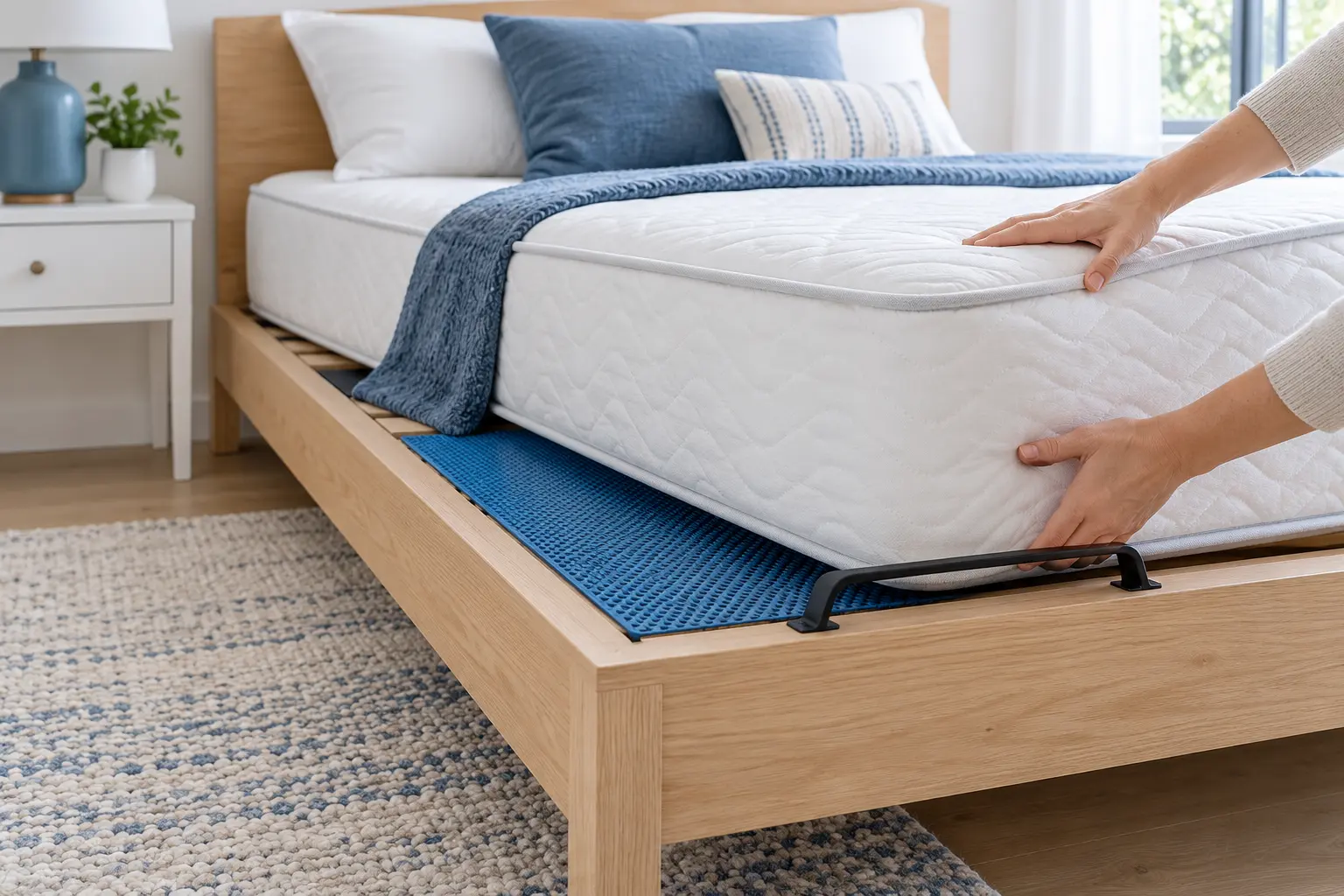
Safe setup: Follow the mattress, foundation and bed-frame instructions. Do not drill new holes, improvise straps, block ventilation or place loose materials near mechanisms. Power down an adjustable base before inspection, keep every accessory away from hinges, motors and cables, and ask for help rather than lifting a heavy mattress alone.
Why does the mattress keep sliding?
First separate mattress movement from bed movement. Place a removable paper marker at one mattress corner and another at one frame leg. If only the upper marker changes position, focus on the mattress-to-base contact. If the leg moves too, a mattress product will not stabilize the whole bed.
Next inspect the fit with the bedding removed. A wide gap on every side suggests the mattress and frame may not be the same intended size. One smooth surface can also slide over another even when the dimensions match. On a split setup, two mattresses can move toward the outside and create a center gap. These causes need different products.
Stop and follow the manufacturer’s service guidance if supports are loose, broken, sharply uneven or missing. A gripper pad or gap wedge should never hide a support problem.
A five-minute movement diagnosis
| What you observe | What it points to | Check before buying | Appropriate first action |
|---|---|---|---|
| Mattress marker moves; frame-leg marker does not | Mattress-to-base fit or surface contact | Mattress footprint, supported area, surface condition and support instructions | Correct a size or support issue first; otherwise compare a compatible full-size gripper pad |
| Mattress and frame-leg markers move together | The complete bed is moving on the floor | Floor type, leg condition, loose hardware and the frame maker’s instructions | Stabilize the frame-to-floor contact; a mattress pad will not solve this |
| Movement repeats toward one edge | Directional travel on an otherwise stable base | Approved attachment points, clearance and mattress contact height | Consider only a frame-compatible retainer with no hard pressure point |
| Two mattresses open a center seam | Mattresses or their separate bases are drifting apart | Whether both bases stay aligned and whether the maker permits a perimeter connector | Stabilize the bases first, then compare a compatible connector and soft center bridge |
| Mattress stays aligned but items fall behind it | A fixed headboard gap rather than active sliding | Gap width at several points, bed width and mechanism clearance | Use a measured filler only for the remaining gap |
Purple’s current mattress warranty illustrates why support comes before accessories: it requires a sturdy frame and specifies foundation and slat conditions for its own mattresses. Those numbers are brand-specific, not a universal standard, so use the instructions for your exact mattress and base.
What should you measure before buying a mattress grip solution?
Compare the measurements with both the bed and mattress documentation. The goal is full, even support and a product used in its intended location, not maximum friction at any cost.
Which products can stop a mattress from sliding?
Affiliate disclosure: The Amazon links below are affiliate links. As an Amazon Associate, ProblemPick earns from qualifying purchases. The recommended product type still starts with the movement diagnosis, measurements and manufacturer compatibility—not a current offer.
Full-size nonslip mattress pad
Best when one mattress slides across a flat platform or box springA purpose-built gripper pad sits between the mattress and the stable base to add friction across a broad area. It is the simplest first product when the sizes match and the whole mattress shifts together.
- Benefits
- Covers a broad contact area
- Adds no hard parts around the bed edge
- Can be removed for cleaning or inspection
- Check before buying
- Measure the supported mattress footprint and compare it with the pad dimensions. Confirm the maker allows the material on both the mattress cover and the base, and check cleaning, airflow and care instructions. Keep every edge flat and fully beneath the mattress.
- Possible drawback
- It cannot correct an oversized frame, loose slats or a moving bed base. A pad that bunches, curls or is too small can create uneven support instead of consistent grip.
Fitted box-spring or base cover
Best when the mattress slides on a smooth fabric-covered foundationA fitted cover can give a worn or very smooth foundation a more consistent contact surface while also keeping the base covered. Choose a version specifically described for the foundation type rather than improvising with loose fabric.
- Benefits
- Creates one fitted surface over the base
- May be easier to wash than the foundation
- Adds no separate edge hardware
- Check before buying
- Measure base length, width and depth. Check the top-surface material, elastic range, care instructions and whether the cover is intended to sit beneath a mattress. It must remain smooth without blocking labels, ventilation or moving sections.
- Possible drawback
- A cover may still move if its elastic is loose, and a smooth model may add little grip. It does not solve a mattress that is the wrong size for the frame.
Frame-compatible mattress retainer
Best when a compatible platform or metal frame allows a physical edge stopA low-profile retainer bar or stop blocks movement at the edge instead of relying only on friction. It can be useful when the mattress repeatedly travels in one direction and the frame maker provides a suitable attachment point.
- Benefits
- Targets a clear direction of travel
- Does not depend on adhesive
- Can remain in place during routine sheet changes
- Check before buying
- Verify exact frame and mattress compatibility, attachment method, installed height, rounded contact surfaces and required clearance. Use only approved holes or mounting points. On adjustable bases, follow the base maker's instructions and keep hardware clear of hinges, motors, cables and moving sections.
- Possible drawback
- Generic retainers may not fit the frame and hard hardware can press against the mattress if positioned badly. Installation is unsuitable where the frame provides no approved mounting point.
Split-mattress connector set
Best when two adjacent mattresses drift apart from each otherA purpose-built connector usually combines a perimeter strap with a soft center bridge. The strap keeps compatible mattresses together while the bridge reduces the center gap, addressing a different problem from one mattress sliding across its base.
- Benefits
- Addresses two mattresses separating
- Can reduce the center gap at the same time
- Removes without permanent frame changes
- Check before buying
- Confirm the set fits both mattress dimensions and the complete perimeter. Check buckle placement, bridge width, fabric care and whether the bed maker allows a connector. Do not route a strap around moving split-adjustable sections unless both makers explicitly permit it.
- Possible drawback
- The strap can loosen or be awkward to fit, and the bridge may change how the center feels. It is not a fix for two bed bases that move independently on the floor.
Headboard gap filler wedge
Best when the practical problem is pillows or small items falling into the gapA purpose-built wedge fills the space left when the mattress sits away from the headboard. It manages the gap immediately while you separately diagnose why the mattress or frame moves.
- Benefits
- Stops small items entering the headboard gap
- Installs without changing the frame
- Useful even when a small fixed gap remains
- Check before buying
- Measure gap width, bed width and the space below the headboard. Check firmness, cover care and how the wedge stays positioned. Keep it clear of adjustable mechanisms and never use a gap filler as a substitute for a correctly supported mattress.
- Possible drawback
- It treats the gap, not the movement. A wedge can compress, shift or take up sleep-surface space, so it should not hide an incorrect frame size or unstable base.
ProblemPick compares product types, not current offers. Amazon shows products, prices, ratings, availability and seller terms only after you choose to open a link.
Quick comparison: which mattress-stability product fits?
| Product type | Best use | Main limitation |
|---|---|---|
| Full-size nonslip mattress pad | Best when one mattress slides across a flat platform or box spring | It cannot correct an oversized frame, loose slats or a moving bed base. A pad that bunches, curls or is too small can create uneven support instead of consistent grip. |
| Fitted box-spring or base cover | Best when the mattress slides on a smooth fabric-covered foundation | A cover may still move if its elastic is loose, and a smooth model may add little grip. It does not solve a mattress that is the wrong size for the frame. |
| Frame-compatible mattress retainer | Best when a compatible platform or metal frame allows a physical edge stop | Generic retainers may not fit the frame and hard hardware can press against the mattress if positioned badly. Installation is unsuitable where the frame provides no approved mounting point. |
| Split-mattress connector set | Best when two adjacent mattresses drift apart from each other | The strap can loosen or be awkward to fit, and the bridge may change how the center feels. It is not a fix for two bed bases that move independently on the floor. |
| Headboard gap filler wedge | Best when the practical problem is pillows or small items falling into the gap | It treats the gap, not the movement. A wedge can compress, shift or take up sleep-surface space, so it should not hide an incorrect frame size or unstable base. |
Which option matches the way the mattress moves?
Does one mattress slide across a stable flat base?
Start with a full-size purpose-built gripper pad. It should cover most of the supported footprint, lie completely flat and be compatible with both contact surfaces.
Is the box spring or foundation fabric unusually smooth?
Compare a fitted base cover with an appropriate top surface. A fitted cover is easier to inspect than a loose layer, but it must remain taut and correctly sized.
Does the mattress repeatedly move toward the foot?
Use a physical retainer only when the exact frame provides an approved attachment point. Confirm its height and contact edge before installing it.
Do two mattresses separate in the middle?
Choose a split-mattress connector set after confirming that both bases themselves stay aligned. Use the center bridge to manage the seam, not to hold moving frames together.
Do pillows fall into a fixed headboard gap?
A measured gap filler can solve that symptom after the mattress is correctly supported. Do not rely on the wedge to correct movement or an oversized frame.
How do you test the solution without hiding another problem?
If the mattress stays put but the fabric still lifts, use the separate guide to keep a fitted sheet from coming off. For other bedroom improvements, compare ways to make a bright bedroom darker. Browse more focused comparisons in Sleep and Home.
Mattress anti-slip buying checklist
What this decision guide is based on
- Purple mattress warranty: frame and foundation requirements — a manufacturer example showing why sturdy support, center support and slat spacing must be checked before adding a grip accessory.
- U.S. Occupational Safety and Health Administration: ergonomics — general guidance supporting safer handling and avoiding unnecessary strain when moving heavy objects.
Mattress-sliding FAQs
Why does my mattress keep sliding?
Common causes include a very smooth contact surface, a mattress that is smaller than the usable frame area, loose or uneven supports, a base that moves on the floor, or two separate mattresses drifting apart. Identify what moves and in which direction before choosing a product.
What is the easiest way to stop a mattress sliding on a platform bed?
If the platform is stable, flat and correctly sized, a purpose-built full-size nonslip mattress pad is usually the least complicated starting point. Measure the supported area and confirm the pad material is allowed on both surfaces.
Can I use a rug pad under a mattress?
Use only a product whose maker describes it as suitable between a mattress and its base. A general rug pad may have different materials, dimensions, care needs or surface compatibility, so it should not be assumed to work safely in a bed setup.
How do I stop two mattresses from sliding apart?
Check that both bases are aligned and stationary, then compare a purpose-built split-mattress connector strap and center bridge. Confirm the total perimeter, buckle position and compatibility, especially for split adjustable beds.
Are mattress retainers safe for adjustable beds?
Only use a retainer that the adjustable-base maker allows for that exact frame. It must stay clear of hinges, motors, cables and moving sections. Power the base down before inspection or installation and never work beneath a moving base.
Will a headboard gap filler stop the mattress moving?
Not necessarily. A gap filler prevents pillows or small items falling into the space, but it does not correct the reason the mattress or bed base moves. Treat it as a gap solution while resolving the underlying fit or grip problem.