 ProblemPick
How to Keep Travel Documents and Small Essentials Organized
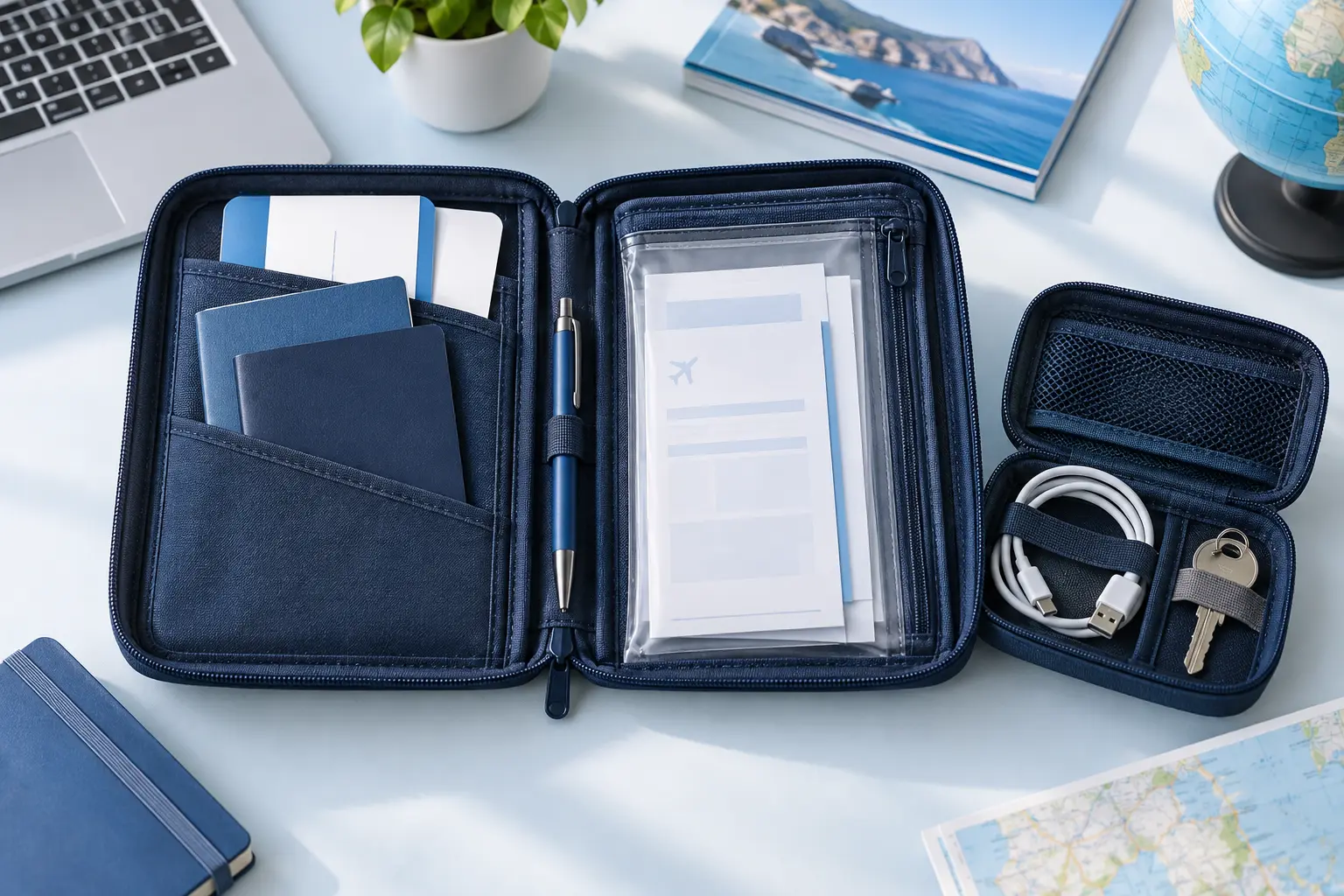
Give every required original one fixed slot, keep copies separate, and place the organizer in the same closed personal-item pocket after every check. Choose a zipped wallet for several passports, a slim sleeve for a light solo kit, a wearable pouch for transfers, a clear pouch for changing paperwork and a separate small case for cables, a pen and a key.
Current rules decide what you carry: An organizer does not confirm passport validity, visa, consent-letter, identification or entry requirements. Check official sources for the complete itinerary shortly before travel and carry the physical originals they require.
What should you organize before buying a travel wallet?
List the documents each traveler must present and when: booking, departure, transfer, arrival, vehicle collection or lodging. Verify that list with the responsible government, carrier and destination sources. The U.S. Department of State international travel checklist, updated August 11, 2025 and checked September 23, 2026, tells travelers to review destination-specific entry and passport-validity requirements, gather the required documents and keep carried copies separate from the originals.
Lay the verified originals on a clean surface, then add only papers needed for the next stage. Put old receipts, loyalty cards and general packing notes elsewhere. Count the final items and measure the largest booklet or folded sheet; this is the load the organizer must fit without bending or forcing its closure.
Which product type fits your document routine?
Zipped travel document wallet
Best for one person or family carrying several passports and printed confirmationsA full-size wallet gives passports, boarding documents and cards separate visible zones inside one closure. It is most useful when one adult manages the group's papers, but it should remain slim enough to open without spilling or exposing every item.
- Benefits
- Keeps a travel party's papers together
- Creates repeatable places for passports and cards
- Can move as one unit between bags
- Before you buy
- Count passports and documents after confirming the official requirements. Compare internal slot size, full external dimensions, closure clearance and whether the loaded wallet fits the exact personal-item pocket you will use.
- Possible drawback
- One wallet becomes a single point of inconvenience if it is misplaced, and an overfilled model can be slow to search at a checkpoint.
Slim passport-and-card sleeve
Best for a solo traveler with only a few documents to reachA compact sleeve keeps the passport cover and one or two essential cards from rubbing against keys or cables. Its limited capacity also discourages mixing receipts and unrelated loyalty cards with the documents needed next.
- Benefits
- Adds little bulk
- Keeps the next document easy to identify
- Fits smaller personal-item pockets
- Before you buy
- Measure the closed passport and any second booklet or card you must carry. Check slot depth, edge coverage, closure style and whether the sleeve can be removed from its pocket with one hand without bending the contents.
- Possible drawback
- It does not suit several passports or large folded papers, and a sleeve is not a substitute for keeping track of the bag that contains it.
Wearable document pouch
Best when documents must stay on your person during transfersA neck, waist or crossbody pouch can keep documents attached to the traveler while moving between transport, lodging and checkpoints. Choose it for a comfortable carry position and deliberate access—not because a product promises that loss or theft is impossible.
- Benefits
- Stays attached during busy transfers
- Leaves hands free for luggage
- Can separate originals from less important papers
- Before you buy
- Try the strap range over the clothing you will wear and check seam finish, closure, body-side comfort and loaded thickness. Confirm that the pouch remains permitted and easy to present wherever documents must be shown.
- Possible drawback
- It may feel warm or visible, can be awkward under clothing and can slow access if packed too tightly. No pouch is theft-proof.
Clear zip document pouch
Best for printed itineraries, receipts and papers that change during the tripA transparent flat pouch keeps loose paper together while letting you identify the group without emptying it. It works well for documents that are useful but do not need a dedicated passport slot.
- Benefits
- Makes paper groups visible
- Contains receipts and small confirmations
- Easy to label outside without marking documents
- Before you buy
- Fold or print papers to the planned size, then compare the pouch's usable internal dimensions, closure and material care. If water resistance matters, rely only on the maker's stated specification and keep irreplaceable originals separately protected.
- Possible drawback
- A full pouch becomes bulky and transparent sides reveal what is inside. It should not hold every sensitive original in one place.
Small essentials organizer
Best for the cable, pen and key needed alongside documentsA shallow zip case prevents a charging cable, pen and accommodation key from entering the document wallet. Keeping these hard items separate protects paper edges and gives the travel kit a clear two-part structure: identity and booking papers in one place, small tools in another.
- Benefits
- Separates hard objects from paper
- Makes missing small items easier to notice
- Limits cable and key clutter
- Before you buy
- Lay out only the small items used during the journey. Check pocket depth, cable bend space, zipper path and the loaded case's fit beside—not on top of—the document wallet.
- Possible drawback
- Too many loops add bulk, and an oversized case can duplicate the electronics organizer already in the carry-on.
ProblemPick compares product types, not current listings. Amazon shows current products, prices, ratings, availability and seller terms after you choose to open it.
Travel document organizer comparison
| Product type | Best for | Main limitation |
|---|---|---|
| Zipped travel document wallet | Best for one person or family carrying several passports and printed confirmations | One wallet becomes a single point of inconvenience if it is misplaced, and an overfilled model can be slow to search at a checkpoint. |
| Slim passport-and-card sleeve | Best for a solo traveler with only a few documents to reach | It does not suit several passports or large folded papers, and a sleeve is not a substitute for keeping track of the bag that contains it. |
| Wearable document pouch | Best when documents must stay on your person during transfers | It may feel warm or visible, can be awkward under clothing and can slow access if packed too tightly. No pouch is theft-proof. |
| Clear zip document pouch | Best for printed itineraries, receipts and papers that change during the trip | A full pouch becomes bulky and transparent sides reveal what is inside. It should not hold every sensitive original in one place. |
| Small essentials organizer | Best for the cable, pen and key needed alongside documents | Too many loops add bulk, and an oversized case can duplicate the electronics organizer already in the carry-on. |
Which organizer should you choose first?
Are you managing documents for several travelers?
Use a zipped document wallet with one labelled or visually distinct slot per person. Return each passport immediately rather than building a temporary pile after the checkpoint.
Is your solo document set very small?
Choose a slim passport-and-card sleeve. Keep receipts and cables elsewhere so the sleeve remains easy to identify and remove.
Do you change transport and lodging several times?
A comfortable wearable pouch can keep the active document set attached during transfers. Test access while standing and carrying luggage; do not rely on security claims as a substitute for attention.
Do printed confirmations and receipts keep spreading?
Use one flat clear pouch for changing paper and empty it regularly. Keep sensitive originals in their assigned closed organizer rather than mixing everything together.
Do cables and keys damage paper edges?
Add one shallow essentials case beside the document wallet. If the carry-on already has an electronics organizer, use that instead of buying a duplicate.
How do you keep documents organized during the trip?
This guide complements our broader carry-on organization guide, which covers clothing, liquids and electronics at bag level. Browse more focused solutions in the Travel guide collection.
Travel document organizer buying checklist
Travel document organization FAQs
Should all family passports stay in one organizer?
One organizer can simplify checkpoints when one adult is responsible for the group, but agree who carries it and return every passport to its assigned slot immediately. Consider keeping copies and nonessential papers separately so one wallet does not contain every record.
Where should a travel document wallet go?
Use a closed, repeatable pocket in the personal item or a comfortable pouch that stays with you. The location should be reachable without opening the main suitcase, yet not so exposed that documents can fall out during normal movement.
Should I keep copies with the originals?
No. The U.S. State Department recommends multiple copies and says a set carried during travel should stay separate from the originals. Follow the current guidance for your nationality and destination.
Is an RFID-blocking wallet necessary?
This guide does not treat RFID claims as a deciding factor. Start with measured fit, reliable closure, access and a carry location you will use consistently. Evaluate any additional claim from the maker's evidence rather than assuming every lined wallet performs the same way.
How do I stop receipts from filling the passport wallet?
Give receipts one small flat zip pouch or envelope and clear it at a planned time. Keep only papers that have a defined purpose; move them out of the passport slots as soon as they are no longer needed for the next stage.
Can digital copies replace physical travel documents?
Do not assume they can. Entry, carrier and identification requirements vary. Check the current official rules for the full itinerary and carry the physical originals required for your trip.