 ProblemPick
Blankets Piling Up? Try These Living-Room Storage Ideas
Keep everyday throws in an open basket, display a small group on a blanket ladder, hide larger stacks in a storage ottoman, use measured space beneath a sofa with a rolling bin, or move seasonal blankets into a lidded soft box. Fold the bulkiest blanket and measure the full storage route before buying.
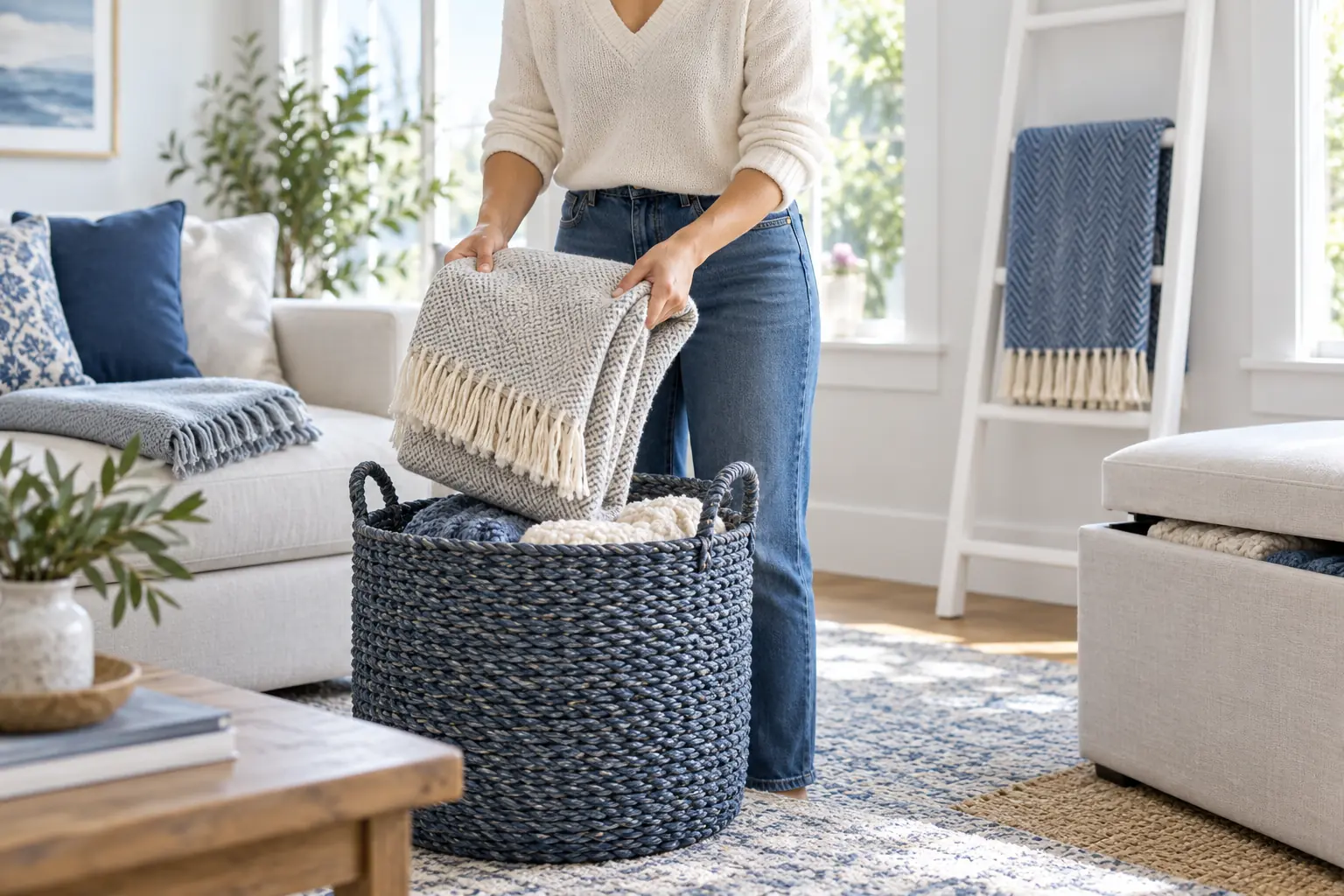
Keep the route clear: Follow the storage product and textile care instructions. Do not block doors, heaters, vents, floor registers, sofa mechanisms or walking space. Keep lids, hinges and freestanding furniture outside children's play routes, and store only clean, fully dry textiles.
Why do blankets keep piling up on the sofa?
The storage may be too far from the seating area, too small for the thickest throw or too awkward to open with one hand. When everyday, guest and seasonal blankets share one deep container, the useful item often ends up on top of the sofa because returning it means unpacking everything else.
Collect the blankets from the room and divide them by daily, occasional and seasonal use. Set aside anything that needs cleaning or repair. This prevents a decorative container from becoming the new problem: an overfilled basket still leaves no reliable place for the blanket in your hands.
If the sofa itself will not stay arranged, first use the separate guide to keep couch cushions from sliding. For a nearby small surface, our bedside-table guide shows the same visible-versus-contained decision on a smaller scale.
What should you measure before choosing blanket storage?
Which living-room blanket storage type fits?
Large open basket with handles
Best for a few everyday throws that need a fast one-step resetA wide basket beside the sofa keeps frequently used blankets visible and reachable. Handles make the whole group easier to move when cleaning or changing the room layout.
- Benefits
- Fast access and return
- Moves as one container
- No installation required
- Check before buying
- Fold the bulkiest blanket, measure the stack and add hand space. Check the basket opening, base diameter, loaded weight, handle attachment, cleanable lining and whether the weave can snag loose loops or fringe.
- Possible drawback
- An open basket shows the top layer, collects dust and can turn into an overfilled heap. Coarse weave may catch delicate knits.
Freestanding blanket ladder
Best for two or three light throws that should air between usesSeparate rungs give each throw a visible place without using shelf depth. A freestanding model can sit in a narrow wall zone when the floor and wall contact points are suitable.
- Benefits
- Keeps throws individually visible
- Uses vertical space
- Easy to rotate by season
- Check before buying
- Measure height, footprint, rung spacing and the blanket drop on both sides. Follow stability, wall-clearance and load instructions; place it outside doors and walking routes and confirm the finish will not transfer to fabric or wall.
- Possible drawback
- It remains visually open, suits only a small number of lighter blankets and can become unstable or obstructive if overloaded or poorly placed.
Storage ottoman or bench
Best when closed storage and an extra approved furniture function can share one footprintA hinged or lift-off top hides several folded throws while the outside may also work as a footrest or seat when the manufacturer rates it for that use. The opening brings a complete stack close to the sofa.
- Benefits
- Hides visual clutter
- Combines storage with usable furniture
- Keeps blankets close to seating
- Check before buying
- Measure exterior size, interior opening, usable depth and lid-swing space. Check the stated load, hinge or soft-close design, ventilation, floor protection and whether small hands or pets can reach the mechanism.
- Possible drawback
- It uses permanent floor space, access is blocked when objects sit on top and deep interiors encourage heavy, compressed stacks.
Low rolling bin for under-sofa storage
Best when a sofa or console has unused clearance and the front pull-out route stays openA shallow container turns otherwise unused low depth into a pull-out zone. A fitted lid can reduce dust while a handle or restrained wheels make the contents easier to bring forward.
- Benefits
- Uses hidden low space
- Brings the stack forward
- Can protect from everyday dust
- Check before buying
- Measure the narrowest clearance, full usable depth, wheel height and pull-out distance. Confirm floor compatibility, loaded weight, lid clearance and that no sofa mechanism, cable, vent or cleaning access is blocked.
- Possible drawback
- It will not fit low-framed or reclining sofas, wheels need a clear path and the bin must be removed regularly for floor cleaning.
Lidded soft storage box
Best for seasonal or guest blankets on a shelf, wardrobe floor or stable low stackA structured fabric box groups less-used blankets and shields them from normal room dust. A label window or clear panel helps identify contents without repeatedly opening every box.
- Benefits
- Contains seasonal groups
- Soft sides suit shelves and closets
- Labels make contents easier to find
- Check before buying
- Measure the folded blanket volume, shelf opening and space needed to lift the lid. Check seam strength, empty and loaded weight, cleanability, ventilation and whether the box is designed to stack when full.
- Possible drawback
- Soft walls can bow, frequent access is slower and tightly packed closed storage is unsuitable for blankets that are not fully dry.
ProblemPick compares product types, not current offers. Amazon shows products, prices, ratings, availability and seller terms only after you choose to open a link.
Quick comparison: which blanket holder fits?
| Storage type | Best use | Main limitation |
|---|---|---|
| Large open basket with handles | Best for a few everyday throws that need a fast one-step reset | An open basket shows the top layer, collects dust and can turn into an overfilled heap. Coarse weave may catch delicate knits. |
| Freestanding blanket ladder | Best for two or three light throws that should air between uses | It remains visually open, suits only a small number of lighter blankets and can become unstable or obstructive if overloaded or poorly placed. |
| Storage ottoman or bench | Best when closed storage and an extra approved furniture function can share one footprint | It uses permanent floor space, access is blocked when objects sit on top and deep interiors encourage heavy, compressed stacks. |
| Low rolling bin for under-sofa storage | Best when a sofa or console has unused clearance and the front pull-out route stays open | It will not fit low-framed or reclining sofas, wheels need a clear path and the bin must be removed regularly for floor cleaning. |
| Lidded soft storage box | Best for seasonal or guest blankets on a shelf, wardrobe floor or stable low stack | Soft walls can bow, frequent access is slower and tightly packed closed storage is unsuitable for blankets that are not fully dry. |
Which option suits your living room?
Do blankets return to the sofa every day?
Choose a broad basket close to the seating area. Size it for the folded daily group, not the complete household collection.
Do you want two favorite throws visible?
A blanket ladder separates them on individual rungs. Keep the drape within its footprint and follow stability and load instructions.
Do you need the blankets hidden but still nearby?
A storage ottoman or bench works when its full footprint and lid movement fit. Confirm every furniture use the maker allows.
Is there genuinely free space below the sofa?
Choose a low rolling bin only after measuring the lowest rail and checking all mechanisms. Keep the pull-out route open.
Are the blankets used only by guests or in another season?
Use a labeled lidded soft box on a reachable shelf or wardrobe floor. Pack textiles loosely enough to remove one without disturbing every layer.
How do you set up blanket storage that stays tidy?
Browse more focused ideas in the Home and Organization collections.
Living-room blanket storage buying checklist
Living-room blanket storage FAQs
What is the easiest way to store blankets in a living room?
For blankets used most days, a wide open basket beside the sofa is usually the simplest reset. Keep only a loose daily group inside and move seasonal or guest blankets to closed storage.
Should blankets be folded or rolled for storage?
Use the method that fits the blanket and container without stretching, crushing or hiding the whole collection. Folded stacks suit shelves and boxes; a loose roll may fit a tall basket. Follow the textile care label for delicate materials.
Can blankets be stored under a sofa?
Yes, when there is enough measured clearance and the container does not block a recliner mechanism, vent, cable, cleaning route or floor register. Use a removable low bin and clean beneath it regularly.
Are blanket ladders stable enough for a busy room?
Only when the product is placed and loaded exactly as its maker directs on a suitable surface. Keep it outside walking and door routes, do not let children climb it and do not exceed the stated load.
How do I keep stored blankets from smelling stale?
Store only clean, fully dry blankets, avoid compressing them into a damp or unventilated container and follow each textile's care instructions. Empty and clean the storage itself before returning the blankets.
How many throw blankets should stay in the living room?
There is no universal number. Keep the group that fits loosely in the chosen daily container and is actually used. Move the rest to labeled seasonal storage so every blanket can be reached without emptying the room.