 ProblemPick
How to Keep an Area Rug From Sliding
Match the grip to the surface beneath the rug. Use a full-size pad or thin underlay for broad movement on a compatible hard floor, corner grippers for lifting corners, floor-approved tape when clearance is very tight, and a rug-over-carpet anchor only for fitted carpet.
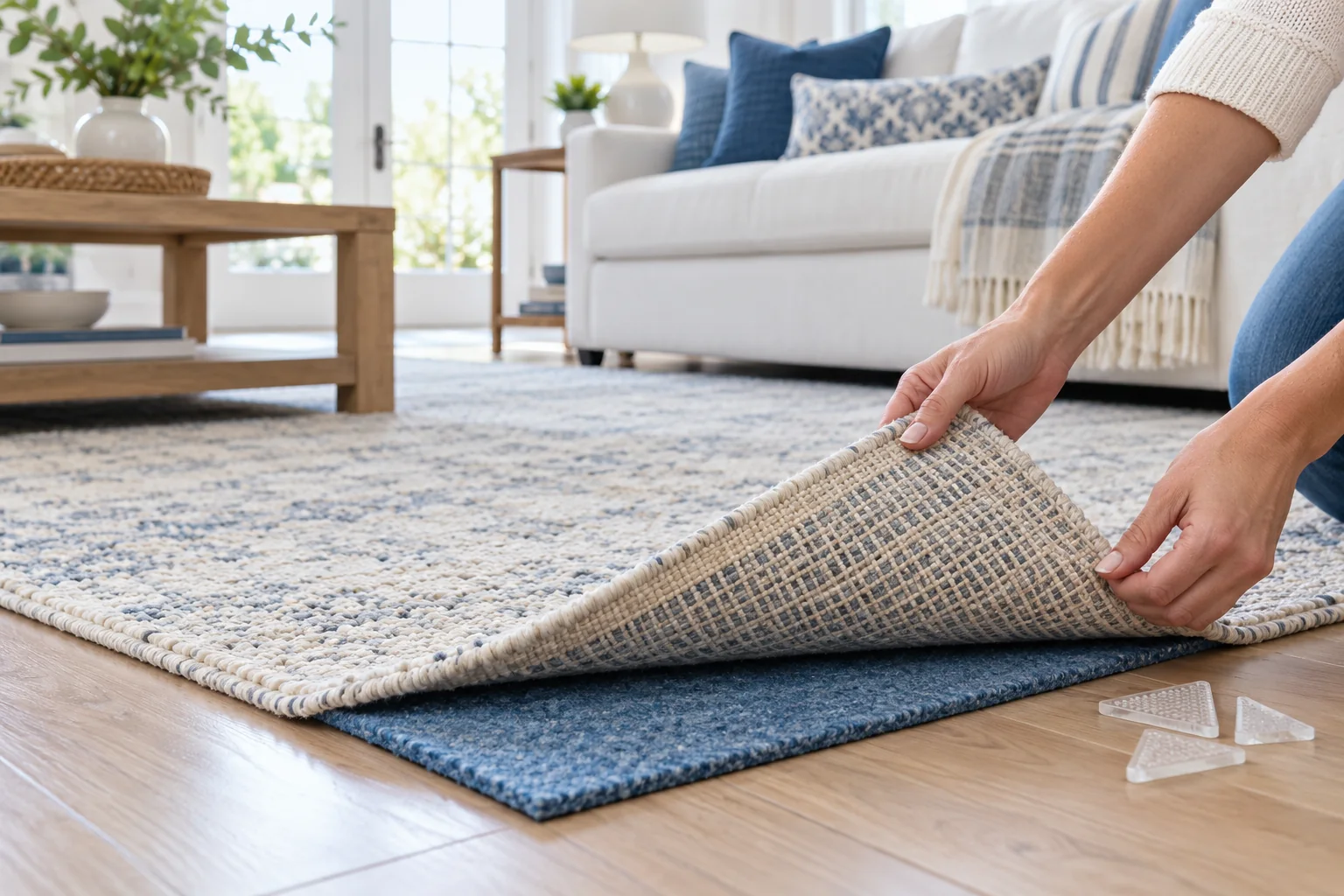
Use the right surface: Follow the flooring, rug and grip-product instructions. Test materials out of sight, keep grit from becoming trapped beneath the rug and inspect the floor during cleaning. This guide covers loose area rugs on flat room floors, not stairs, emergency exits or permanently installed flooring.
Why does the rug keep moving?
Watch what happens before buying anything. A rug that travels as one flat piece needs broad underside grip. A corner that turns upward needs a targeted solution. A runner pushed by a door needs very low added height, while a rug that creeps on fitted carpet needs a product made for a compressible pile rather than a hard floor.
Clean both surfaces according to their care instructions and inspect the rug backing. Dust, grit, a crumbling coating, old adhesive or curled edges can prevent full contact. If the backing is breaking down or the rug no longer lies flat, address that condition instead of hiding it beneath a stronger adhesive.
Also note what moves the rug. A chair, door or furniture leg can repeatedly push it in one direction. A grip product can reduce ordinary movement, but it should not be used to force a rug into a space with insufficient door clearance or awkward furniture pressure.
What should you measure before buying a rug grip?
A full pad normally sits slightly inside the rug edge so it remains hidden. Do not assume a thicker pad is always better: extra height changes the edge profile and can interfere with doors. For an irregular rug, make a simple paper outline or measure several points before trimming an underlay.
Which products can keep an area rug from sliding?
Full-size cushioned rug pad
Best for a room-size rug on a compatible hard floor when you also want a more substantial layerA pad cut slightly inside the rug edges supports most of the rug rather than gripping only four corners. The broad contact area can help a rug stay flatter while adding a separate layer between its backing and the floor.
- Benefits
- Supports most of the rug area
- Keeps hardware away from visible corners
- Can be trimmed to follow the rug shape
- Check before buying
- Measure the rug, including any uneven handmade edge, then compare pad thickness with door clearance and furniture height. Confirm that the pad material is approved by both the flooring and rug makers, especially for sealed wood, vinyl, laminate, stone or a heated floor.
- Possible drawback
- A pad that is too thick can create a raised edge or interfere with doors. The wrong material may transfer residue, mark a finish or hold debris against the floor.
Thin open-weave non-slip underlay
Best for a lightweight rug where low height and easy trimming matterA thin grippy mesh sits below the rug with little added thickness. It can suit small and medium rugs that need broad underside contact but cannot accept a thick cushion near a door or low furniture.
- Benefits
- Low-profile layer
- Easy to trim around an irregular shape
- Covers more area than individual corner pieces
- Check before buying
- Check the underlay's approved floor surfaces, heat exposure, cleaning method and replacement guidance. Measure enough coverage to support the rug without showing at the edge, and reject material that curls, crumbles, feels tacky or leaves residue.
- Possible drawback
- Thin mesh provides little cushioning and may lose grip as dust collects. Some materials are unsuitable for particular finishes or heated floors.
Reusable rug corner grippers
Best when an otherwise stable rug curls or shifts mainly at its cornersSmall grippers attach to or sit beneath the corners, targeting movement without covering the full rug underside. Reusable designs are easier to inspect than a permanently bonded installation and can be useful where a large pad is unnecessary.
- Benefits
- Targets lifting or moving corners
- Uses little material
- Easy to inspect individually
- Check before buying
- Confirm whether the gripper attaches to the rug, the floor or both. Check rug-backing compatibility, floor-finish approval, removal instructions, corner thickness and whether the piece can be cleaned or reused. Test one hidden corner before fitting the full set.
- Possible drawback
- Corner-only grip may not stop the middle of a large rug from creeping or rippling. Adhesive or soft polymer surfaces can leave marks if they are wrong for the floor or remain too long.
Floor-compatible double-sided rug tape
Best for a thin edge or runner that needs a low-profile hold and whose materials allow adhesiveTape creates a direct bond at selected edges or across short strips beneath the rug. It adds almost no thickness, which can help when a door passes close to the rug, but it depends heavily on surface compatibility and careful removal.
- Benefits
- Very low profile
- Can target a moving edge
- Cut to the required length
- Check before buying
- Use only tape whose label names both the rug backing and exact floor type. Check finish age, temperature limits, residue guidance and removal method. Test a short strip out of sight and never substitute general mounting, duct or packaging tape.
- Possible drawback
- Adhesive can transfer, pull fibers or affect a floor finish. Tape also complicates lifting the rug for cleaning and usually needs replacement after removal.
Rug-on-carpet anchor or compatible pad
Best when an area rug creeps over fitted carpet rather than a hard floorA rug on carpet moves differently because the carpet pile compresses and shifts beneath it. A product specifically labeled for rug-over-carpet use is designed for that layered surface; ordinary hard-floor mesh may not engage it.
- Benefits
- Designed for a rug-over-carpet setup
- Accounts for a compressible base
- Available as broader pads or targeted anchors
- Check before buying
- Confirm approval for the fitted carpet's pile and the area rug's backing. Check the required coverage, thickness, furniture placement, cleaning access and whether the carpet maker permits an added rug. Watch for ripples after normal walking and furniture movement.
- Possible drawback
- No anchor can correct severe rippling, incompatible backings or a rug trapped awkwardly by furniture. Added layers may make vacuuming and repositioning harder.
ProblemPick compares product types, not current offers. Amazon shows products, prices, ratings, availability and seller terms only after you choose to open a link.
Quick comparison: which rug-grip option fits?
| Product type | Best use | Main limitation |
|---|---|---|
| Full-size cushioned rug pad | Best for a room-size rug on a compatible hard floor when you also want a more substantial layer | A pad that is too thick can create a raised edge or interfere with doors. The wrong material may transfer residue, mark a finish or hold debris against the floor. |
| Thin open-weave non-slip underlay | Best for a lightweight rug where low height and easy trimming matter | Thin mesh provides little cushioning and may lose grip as dust collects. Some materials are unsuitable for particular finishes or heated floors. |
| Reusable rug corner grippers | Best when an otherwise stable rug curls or shifts mainly at its corners | Corner-only grip may not stop the middle of a large rug from creeping or rippling. Adhesive or soft polymer surfaces can leave marks if they are wrong for the floor or remain too long. |
| Floor-compatible double-sided rug tape | Best for a thin edge or runner that needs a low-profile hold and whose materials allow adhesive | Adhesive can transfer, pull fibers or affect a floor finish. Tape also complicates lifting the rug for cleaning and usually needs replacement after removal. |
| Rug-on-carpet anchor or compatible pad | Best when an area rug creeps over fitted carpet rather than a hard floor | No anchor can correct severe rippling, incompatible backings or a rug trapped awkwardly by furniture. Added layers may make vacuuming and repositioning harder. |
Which option suits the floor beneath your rug?
Does a large rug slide as one flat piece on a hard floor?
Start with a full-size pad approved for that finish. Choose thickness only after checking doors, edges and furniture height. Broad support is usually more appropriate than trying to hold a large rug at four tiny points.
Is the rug light and close to a door?
A thin open-weave underlay keeps the profile lower. Trim it inside the perimeter and inspect it regularly for dust, curling or material breakdown.
Do only the corners lift or rotate?
Reusable corner grippers target those points with less material. They are not a substitute for broad support when the center of the rug also walks across the floor.
Is there almost no height available?
Compatible removable rug tape is the thinnest option here, but use it only when both makers allow adhesive. Test removal before committing to several long strips.
Is the area rug on fitted carpet?
Choose a rug-over-carpet product for the pile and backing. A mesh sold only for wood or tile is the wrong category, even if it feels grippy in your hand.
How do you fit and check the chosen solution?
If the floor rug stays put but the sofa seat moves, use the separate guide to keep couch cushions from sliding. If pet hair is the problem rather than movement, compare ways to remove pet hair from carpet without damaging it. Browse the Home guides or Organization guides for other focused room solutions.
Rug-grip buying checklist
Sliding-rug FAQs
Why does my area rug keep sliding?
The rug may be too light for its size, its backing may have little grip, dust may be reducing contact, or the product beneath it may not match the floor. Movement can also come from a door, furniture, foot traffic or a rug placed over compressible carpet. Identify where the rug first moves before choosing a product.
Is a rug pad better than rug tape?
A full-size pad is usually the broader, easier-to-inspect option for a compatible hard floor. Tape is thinner and can target an edge, but adhesive compatibility and removal matter. Choose by floor finish, door clearance, rug backing and how often the rug must be lifted for cleaning.
What rug pad is safe for hardwood floors?
Use only a pad that the flooring manufacturer and pad maker approve for the exact wood finish. Do not rely on color or a generic hardwood-safe claim alone. Check material, finish age, heated-floor compatibility, cleaning instructions and any required waiting period after refinishing.
Can rug grippers or tape damage the floor?
They can if the adhesive or polymer is incompatible, if debris is trapped beneath it, or if removal instructions are ignored. Test in an inconspicuous place, inspect periodically and stop if you see residue, discoloration or a change in the finish.
How do I stop a rug from moving on carpet?
Choose an anchor or pad specifically labeled for rug-over-carpet use and compatible with both pile and rug backing. Hard-floor mesh often does not solve movement on a soft base. Recheck for waves after the rug has been walked on and after furniture is moved.
Can I use these products on a rug placed on stairs?
This guide is for flat room floors, not stair runners or loose rugs on steps. Stair installations need a system designed and fitted for that location. Do not improvise with ordinary corner grippers or tape.