 ProblemPick
How to Organize Food Storage Containers and Lids
Pair every lid once, remove unusable or unmatched pieces, nest bases by compatible shape and store lids vertically. Then choose an organizer for the real space: a lid rack for visibility, a handled bin for deep shelves, dividers for a drawer, a shelf riser for unused height or a smaller matching set when the collection no longer works.
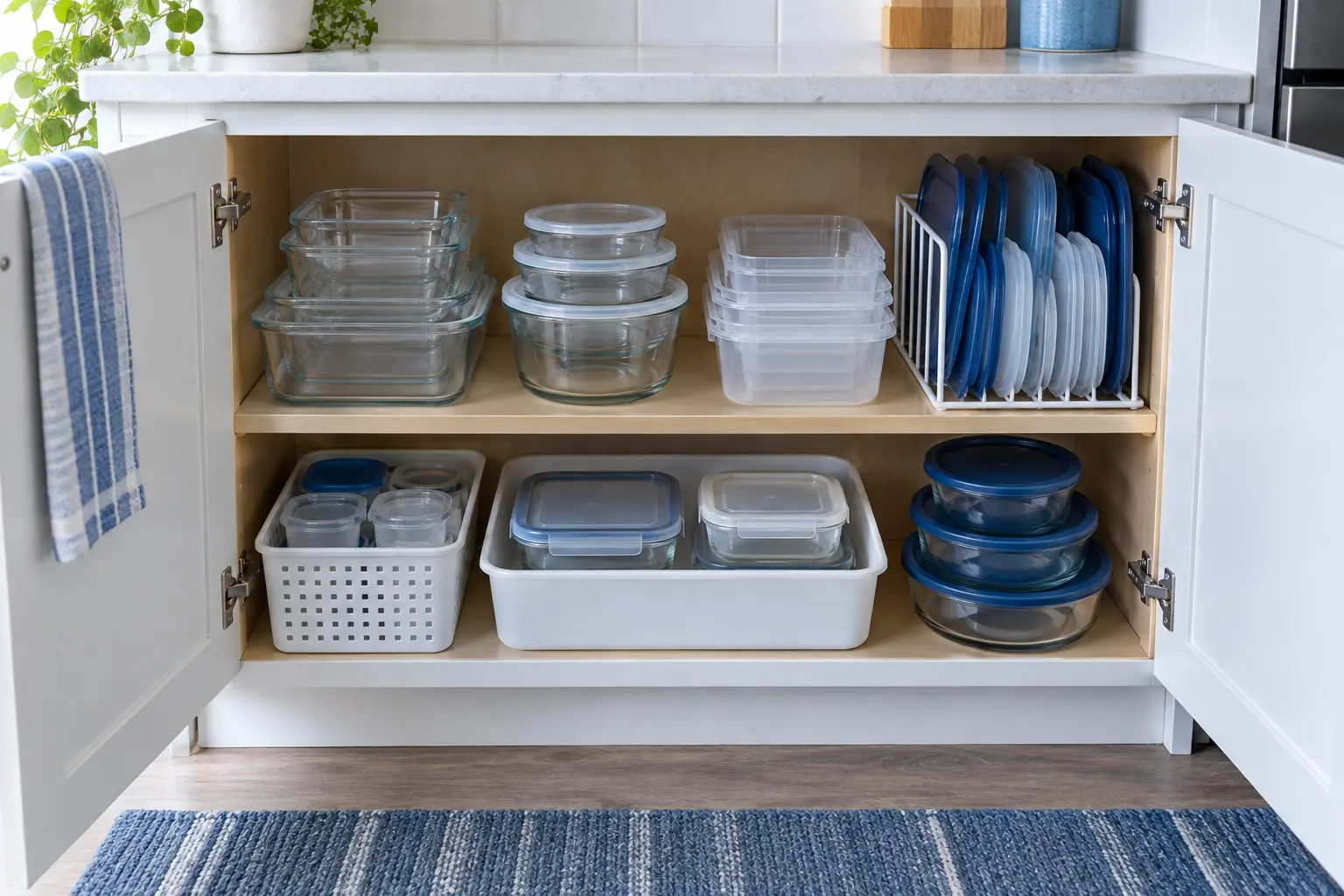
Use containers as intended: Check the maker’s food-contact, temperature, microwave, freezer and dishwasher instructions for each container and lid. Organization does not make an unknown, damaged or incorrectly used item suitable for food.
What should you do before buying an organizer?
Empty the storage zone and match each base with its lid. Set aside cracked, warped or otherwise damaged pieces and follow the maker’s replacement or disposal guidance. Remove lids with no usable base and bases with no lid unless they have a separate, deliberate use. This pairing step reveals the true number, shapes and sizes the organizer must hold.
Next, count what is used during a normal week. Group containers by role—lunch portions, leftovers, bulk prep or very small items—then nest only compatible shapes. Measure the resulting groups and the cabinet opening, not just the shelf inside. Hinges, drawer frames and pipes can reduce the practical space.
Which product type solves your container problem?
Adjustable vertical lid organizer
Best for many flat lids that are hard to see in a pileVertical slots turn lids into visible files, so you can remove one without lifting the whole stack. Adjustable dividers are useful when the collection mixes small, wide and unusually shaped lids.
- Benefits
- Makes individual lids visible
- Reduces unstable horizontal piles
- Can separate lids by shape or container family
- Before you buy
- Measure the organizer's full outside width and depth, the tallest lid, divider spacing and the cabinet opening. Check whether the base stays stable when one side is loaded and whether the finish is suitable for the shelf surface.
- Possible drawback
- A rack consumes some width of its own, very small lids may slip between dividers, and an overfilled section becomes difficult to use.
Open handled storage bin
Best for matched sets on a deep shelf that is difficult to reachA removable bin brings the back of a cabinet forward in one movement. Store a limited group inside—such as lunch containers or large meal-prep boxes—rather than mixing every size together.
- Benefits
- Improves access to deep shelves
- Keeps one container group together
- Can be removed for a quick reset
- Before you buy
- Measure usable shelf depth, width, height and the cabinet opening, including hinges. Compare the bin's internal base dimensions, handle clearance, loaded weight and cleaning instructions.
- Possible drawback
- The bin walls use some cabinet volume, a heavy bin can be awkward to lift, and mixed loose lids can still disappear inside it.
Adjustable drawer dividers
Best for a wide, shallow drawer where containers and lids can stand uprightDividers create measured lanes for lids, small containers and larger bases. They work well when drawer height is sufficient for upright storage and the drawer can still close without catching a rim.
- Benefits
- Uses a low drawer efficiently
- Lets categories change without fixed trays
- Keeps lids from sliding across the drawer
- Before you buy
- Measure internal drawer width, depth and clear height under the frame. Confirm the divider adjustment range, end-pad grip, material care and whether expansion pressure is suitable for the drawer construction.
- Possible drawback
- Dividers do not create more height, may shift if poorly fitted and can press against delicate drawer sides when overtightened.
Cabinet shelf riser
Best when nested containers leave unused height above themA riser creates two reachable levels, allowing shallow containers or matched sets to sit above larger nested bases. It is most useful when both levels remain visible and can be removed without rebuilding the cabinet.
- Benefits
- Uses otherwise empty vertical space
- Separates frequent and occasional sizes
- Can keep complete sets on a distinct level
- Before you buy
- Measure internal cabinet width, depth, shelf height and the tallest item planned for each level. Review leg spacing, surface grip, load limit and whether the riser blocks hinges or shelf-pin holes.
- Possible drawback
- Riser legs take shelf area, low cabinets may become cramped and stacking too many loose pieces on either level recreates the original problem.
Matching nestable container set
Best when many existing bases have no lid and the collection cannot form reliable pairsA deliberately limited set with repeatable shapes can reduce the number of lid families and let empty bases nest. Replacement is worthwhile only after unmatched, damaged or unused pieces have been removed and the new sizes match your routine.
- Benefits
- Reduces incompatible lid shapes
- Nests into a predictable footprint
- Makes missing pieces easier to notice
- Before you buy
- Count the capacities you actually use and compare external and usable internal dimensions. Verify the maker's food-contact purpose, temperature and appliance-use instructions, lid replacement options, nesting layout and care requirements.
- Possible drawback
- Replacing usable containers costs more and creates waste; even a matching set becomes clutter if too many pieces are bought or if replacement lids are unavailable.
ProblemPick compares product types, not current listings. Amazon shows current products, prices, ratings, availability and seller terms after you choose to open it.
Quick product comparison
| Product type | Best for | Main limitation |
|---|---|---|
| Adjustable vertical lid organizer | Best for many flat lids that are hard to see in a pile | A rack consumes some width of its own, very small lids may slip between dividers, and an overfilled section becomes difficult to use. |
| Open handled storage bin | Best for matched sets on a deep shelf that is difficult to reach | The bin walls use some cabinet volume, a heavy bin can be awkward to lift, and mixed loose lids can still disappear inside it. |
| Adjustable drawer dividers | Best for a wide, shallow drawer where containers and lids can stand upright | Dividers do not create more height, may shift if poorly fitted and can press against delicate drawer sides when overtightened. |
| Cabinet shelf riser | Best when nested containers leave unused height above them | Riser legs take shelf area, low cabinets may become cramped and stacking too many loose pieces on either level recreates the original problem. |
| Matching nestable container set | Best when many existing bases have no lid and the collection cannot form reliable pairs | Replacing usable containers costs more and creates waste; even a matching set becomes clutter if too many pieces are bought or if replacement lids are unavailable. |
What should you choose first?
Do lids collapse into a horizontal pile?
Start with a vertical lid organizer. Sort by shape, place the most-used family closest to the opening and leave enough space to return a lid without forcing it.
Is the back of a deep shelf unreachable?
Use one handled bin for one clear category. The bin should slide through the opening without catching the hinges and remain light enough to remove when loaded.
Do containers roll around a low drawer?
Use adjustable dividers to create lanes. Check the tallest container or lid against the drawer’s clear closing height before deciding to store pieces upright.
Is there empty air above a low stack?
A shelf riser can divide the height into two reachable levels. Keep frequent sets on the easiest level and avoid creating tall, loose piles below it.
Are there too many incompatible shapes?
Reduce first. If few reliable pairs remain, compare a limited nestable set based on the sizes you actually use—not the largest piece count advertised.
How can the cabinet stay organized?
If the rest of the room also lacks usable space, start with our broader guide to organizing a small kitchen with limited storage. Browse more focused solutions in the Kitchen guide collection.
Food-container organizer buying checklist
Food-container and lid organization FAQs
Should lids be stored on or off food containers?
For empty everyday storage, separate lids usually let bases nest and use less space. Keep a few complete sets together only when speed matters more than capacity. Follow the maker's storage and care instructions, and make sure every piece is clean and dry first.
What is the best way to organize mismatched lids?
Pair every lid once, remove pieces with no usable match, then group the remaining lids by shape and size in vertical sections. Do not keep an unidentified lid only because it might fit something later.
Are lid organizers better than a storage bin?
A lid organizer is better when visibility and one-at-a-time access are the main problems. A handled bin is better for pulling complete container groups from a deep shelf. Some cabinets benefit from one small lid rack beside one limited bin.
How do I organize containers in a deep cabinet?
Use a removable handled bin for one category, or a shelf riser when unused height is the real problem. Avoid placing loose small pieces behind tall stacks because the back will become inaccessible again.
Should I buy a new matching container set?
Only if the current collection has many missing pairs, unsuitable sizes or damaged pieces. First measure the cabinet and list the capacities used during a normal week; a smaller compatible set is often easier to maintain than a large bundle.
How often should the container cabinet be reset?
Reset it whenever unmatched pieces begin accumulating or the chosen capacity is exceeded. A quick pairing check after unloading the dishwasher usually prevents a separate pile from forming.