 ProblemPick
How to Organize a Small Kitchen With Limited Storage
Start with the jobs your kitchen must support, not with new containers. Keep the main prep area clear, place everyday items near their point of use, and give deep or tall cabinets one measured organizer that solves their specific access problem.
Safety first: Do not add storage that blocks appliance vents, plumbing, electrical panels, outlets, doors or a clear route through the kitchen. Keep anything that can catch fire away from the stovetop, as advised by the U.S. Fire Administration. Put heavy objects low, follow cabinet and organizer load limits, and use the clearances specified by every appliance manufacturer.
How do you reset a small kitchen without making a bigger mess?
Work on one cabinet, drawer or counter section at a time. A complete kitchen emptied at once can hide the original problem and make it harder to finish. Photograph the area, remove its contents, clean the surface according to its material and match every item with its actual lid, accessory or working part.
Sort the contents into daily, weekly, occasional and elsewhere. Daily items need comfortable access. Weekly items can sit behind or above them. Occasional equipment can move to the least convenient safe shelf or another suitable storage area. Anything broken, duplicated beyond your needs or unrelated to kitchen work should not occupy the limited cabinet.
Do this before measuring for products. The space determines the collection that fits; an organizer cannot make an overfilled cabinet easy to use. Leave enough room to lift, slide or rotate the remaining items without forcing them.
Which kitchen zones make limited storage easier to use?
Place an item near the task that uses it, but do not sacrifice safety or a clear work surface. A small kitchen becomes more functional when each cabinet has one purpose and each organizer makes that purpose easier to see.
Five storage products for five different space problems
Removable shelf riser
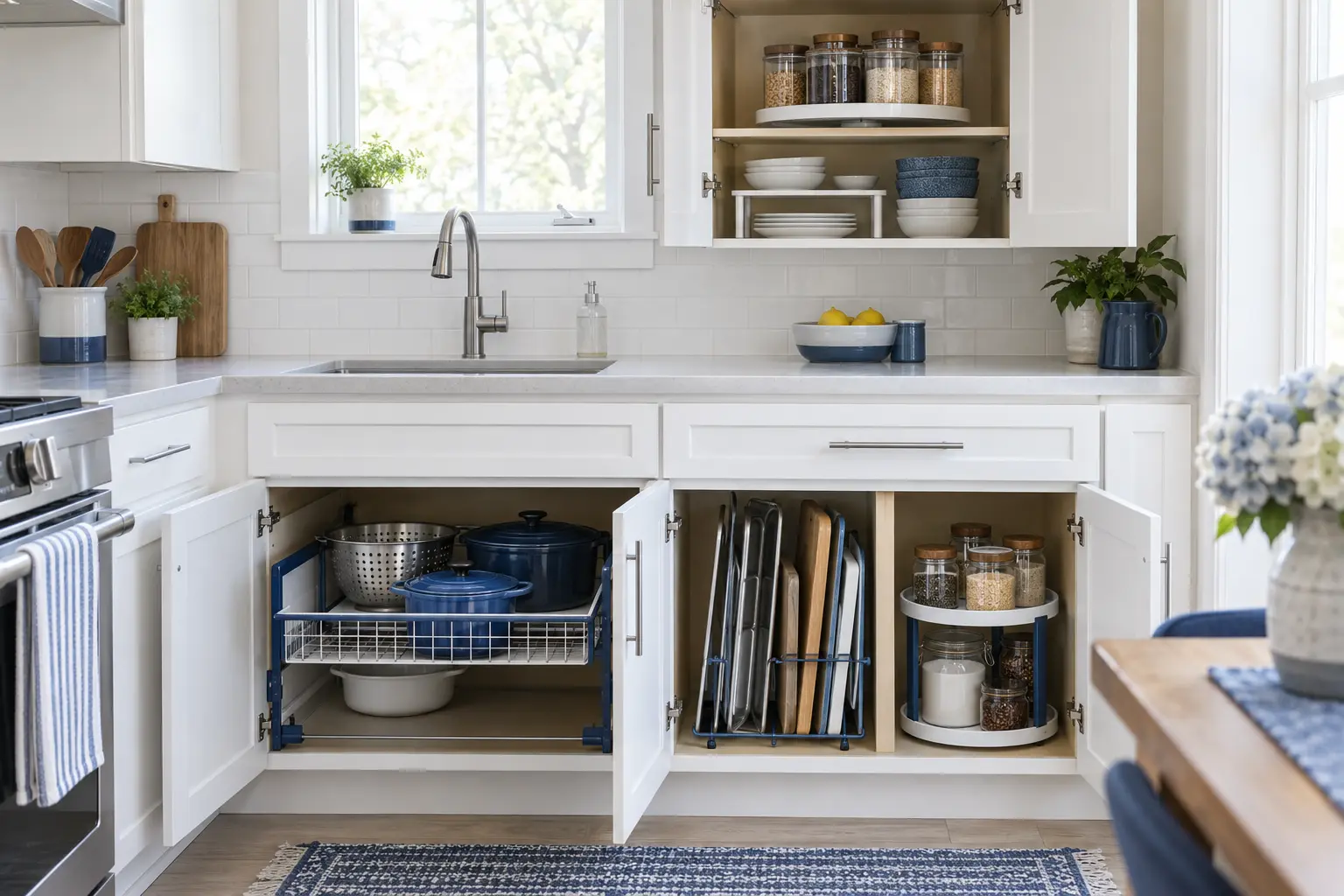
Best for plates, bowls and short pantry packages in a tall cabinetA shelf riser creates a second level inside an existing cabinet. It works well when empty vertical space sits above one low stack, letting you reach the upper and lower groups independently instead of lifting one pile to reach another.
- Benefits
- Uses existing cabinet height
- Separates two frequently used groups
- Usually requires no drilling
- Check before buying
- Measure the cabinet's clear width, depth and height, including hinges and the tallest item below. Compare the riser's load rating, feet, surface finish and stability. Do not stack separate risers unless the maker explicitly permits it.
- Possible drawback
- Fixed legs may waste space around mixed-height items, and an oversized riser can block hinges or make the upper level awkward to reach.
Pull-out cabinet basket
Best for deep lower cabinets where items disappear at the backA pull-out basket brings a group of pots, pantry goods or cleaning accessories toward the cabinet opening. It can make a deep shelf more readable, provided the basket clears the door, hinges and plumbing.
- Benefits
- Improves access to deep storage
- Keeps one category together
- Reduces reaching behind front items
- Check before buying
- Measure the narrowest opening rather than only the cabinet box. Check full extension, mounting method, basket height, load rating and handle clearance. For a rental, compare truly freestanding slide-out bins with products that must be screwed down.
- Possible drawback
- Hardware and basket sides consume some usable width. Heavy loads can be difficult to pull and may require permanent mounting.
Vertical divider rack
Best for baking sheets, cutting boards, pan lids and serving traysA vertical rack turns flat items onto their edges so one piece can be removed without lifting a full stack. It is most useful when the dividers match the thickness and height of the items you actually own.
- Benefits
- Makes flat items individually accessible
- Creates visible categories
- Can use a narrow cabinet section
- Check before buying
- Measure the tallest and widest board or tray, the shelf opening and each divider gap. Confirm that heavy pieces cannot tip the rack and that sharp edges or pan handles will not catch the cabinet door.
- Possible drawback
- Narrow slots may not fit deep pans or boards with handles, while a light rack can shift when a heavy tray is removed.
Compact turntable
Best for jars, condiments and bottles in a corner or deep upper shelfA turntable moves the back of a shelf to the front with a rotation. A low rim helps keep compatible jars together while still showing their labels. It suits one compact category better than a crowded mix of tall and short packages.
- Benefits
- Brings rear items into reach
- Useful in awkward corners
- Makes duplicate jars easier to notice
- Check before buying
- Measure the usable circle with the cabinet door open and allow space around hinges. Compare diameter, rim height, weight capacity and surface grip. Tall bottles should stay stable when the tray turns.
- Possible drawback
- A circle does not use every corner of a rectangular shelf, and unstable bottles can tip if the tray is overloaded or spun quickly.
Slim rolling kitchen cart
Best for a genuine floor gap when every cabinet is already assignedA narrow cart can hold a limited group such as tea supplies, produce that suits room-temperature storage or frequently used serving pieces. Because it is movable, it can serve a rental without changing cabinets.
- Benefits
- Adds storage without remodeling
- Can move to the point of use
- May suit narrow unused floor space
- Check before buying
- Measure the complete route, not just the parking gap: width, handle height, wheels and turning room. Check brakes, stability, shelf lips, load rating and safe distance from heat, water, doors and walkways.
- Possible drawback
- It occupies circulation space, collects visible clutter and can become unstable if heavy objects are placed high or wheels do not lock securely.
ProblemPick compares product types, not individual offers. Amazon shows current products, prices, ratings and availability only after you choose to follow a link.
Quick comparison: which small-kitchen organizer does what?
| Storage type | Best use | Main limitation |
|---|---|---|
| Removable shelf riser | Best for plates, bowls and short pantry packages in a tall cabinet | Fixed legs may waste space around mixed-height items, and an oversized riser can block hinges or make the upper level awkward to reach. |
| Pull-out cabinet basket | Best for deep lower cabinets where items disappear at the back | Hardware and basket sides consume some usable width. Heavy loads can be difficult to pull and may require permanent mounting. |
| Vertical divider rack | Best for baking sheets, cutting boards, pan lids and serving trays | Narrow slots may not fit deep pans or boards with handles, while a light rack can shift when a heavy tray is removed. |
| Compact turntable | Best for jars, condiments and bottles in a corner or deep upper shelf | A circle does not use every corner of a rectangular shelf, and unstable bottles can tip if the tray is overloaded or spun quickly. |
| Slim rolling kitchen cart | Best for a genuine floor gap when every cabinet is already assigned | It occupies circulation space, collects visible clutter and can become unstable if heavy objects are placed high or wheels do not lock securely. |
Which organizer fits the part of your kitchen that feels too small?
Is there empty air above one short stack?
Measure for a removable shelf riser. Use the lower and upper levels for separate groups so neither becomes a double stack that must be unloaded.
Do useful items disappear at the back of a lower cabinet?
Compare pull-out baskets, but measure the door opening, hinges and pipes first. A bin that slides freely inside the box can still collide with the opening.
Do trays and boards form a heavy horizontal pile?
A stable vertical divider can make each piece independently accessible. Keep the heaviest or widest items in the most supported slots and confirm that the rack cannot tip.
Is one corner shelf hard to see?
A compact turntable can bring jars forward. Keep the category narrow and the load balanced; rectangular bins may use more surface area when rotation is not necessary.
Is there a safe narrow floor gap but no cabinet space?
Consider a slim cart only after checking the full path, wheel locks and nearby heat or water. If it narrows a walkway or blocks a door, it is not useful storage.
How do you stop a small kitchen becoming crowded again?
Return items by zone after washing or shopping. If something repeatedly lands on the counter, ask whether its assigned place is too far away, overfilled or difficult to open. Adjust that location before adding another container.
Use a one-in, one-review habit for bulky tools: when a new appliance, pan or storage set arrives, check whether an older item still serves a distinct purpose. Keep a small amount of flexible space for groceries and dishes in motion rather than filling every shelf edge to edge.
Drawers deserve their own measurements and product types. If utensils and small tools keep mixing, use our focused guide to organize a messy kitchen drawer. This article stays centered on cabinets, vertical space and the overall kitchen layout.
Buying checklist for small-kitchen storage
Small-kitchen organization questions
What should stay on a small kitchen counter?
Keep the main preparation area open. Leave out only appliances or tools used often enough to justify their footprint and that can remain there safely under the manufacturer instructions.
How can I add storage without drilling?
Measure for removable shelf risers, freestanding turntables, vertical racks and compatible slide-out bins. A slim cart may also work when it does not obstruct circulation, heat sources or doors.
Are clear bins always better for kitchen cabinets?
No. They make contents visible, but their walls consume space and a deep bin can hide items behind one another. Choose a bin only when containing one category improves access.
Should heavy pots go in an upper cabinet?
Lower storage is usually easier and safer for heavy cookware. Whichever cabinet you use, stay within the cabinet and organizer load limits and avoid awkward lifting.
Can I store things above the refrigerator?
Only if the appliance instructions allow the required ventilation and the items can be reached safely. Avoid heavy, heat-sensitive or rarely inspected items in an awkward high location.
Which organizer should I buy first?
Choose the one that fixes the most repeated access problem after decluttering: a riser for height, pull-out basket for depth, rack for flat items, turntable for a corner or cart for a safe floor gap.