 ProblemPick
Office Chair Scratching the Floor? Try These Fixes
Clean the rolling zone and inspect every caster before covering the floor. Choose a floor-specific chair mat when you want a defined barrier, compatible soft or larger polyurethane casters when the wheels are the problem, or stationary glides when the chair does not need to roll.
Prevention, not floor repair: This guide helps choose a barrier, caster or glide. It does not cover sanding, refinishing or repairing damaged flooring. Follow the floor and chair makers' care, warranty, load and replacement instructions. Do not use the chair with a broken caster, loose base or partly installed wheel set.
What is causing the office chair to mark the floor?
Start with the pattern. Repeated curved lines usually follow the chair's rolling path, while one narrow track can point to a single caster. Small isolated marks may come from grit pressed under a wheel or glide. A cloudy patch beneath a mat is a different problem from a scratch and needs the floor maker's care guidance before another covering is placed over it.
Vacuum or lift loose debris using a method approved for the floor. With the chair unloaded and stable, inspect each caster without dismantling the base. Look for a wheel that does not turn freely, a cracked tread, a rough seam, embedded grit, collected hair or an exposed hard edge. Follow the chair maker's instructions if a caster needs removal or replacement.
Then identify the exact surface: sealed wood, laminate, vinyl, tile, low-pile carpet and deep-pile carpet need different contact materials. Do not assume that a product labeled “floor safe” covers every finish. The mat, caster or glide should name the surface and any limitations.
How much floor does the chair actually use?
A protection mat should keep every caster on the protected surface through normal movement. Replacement wheels need enough space to swivel without touching the chair base, and a larger diameter may raise the seat. Glides need a contact material approved for the floor and enough clearance to sit evenly.
Which products can protect a floor from an office chair?
Hard-floor chair mat
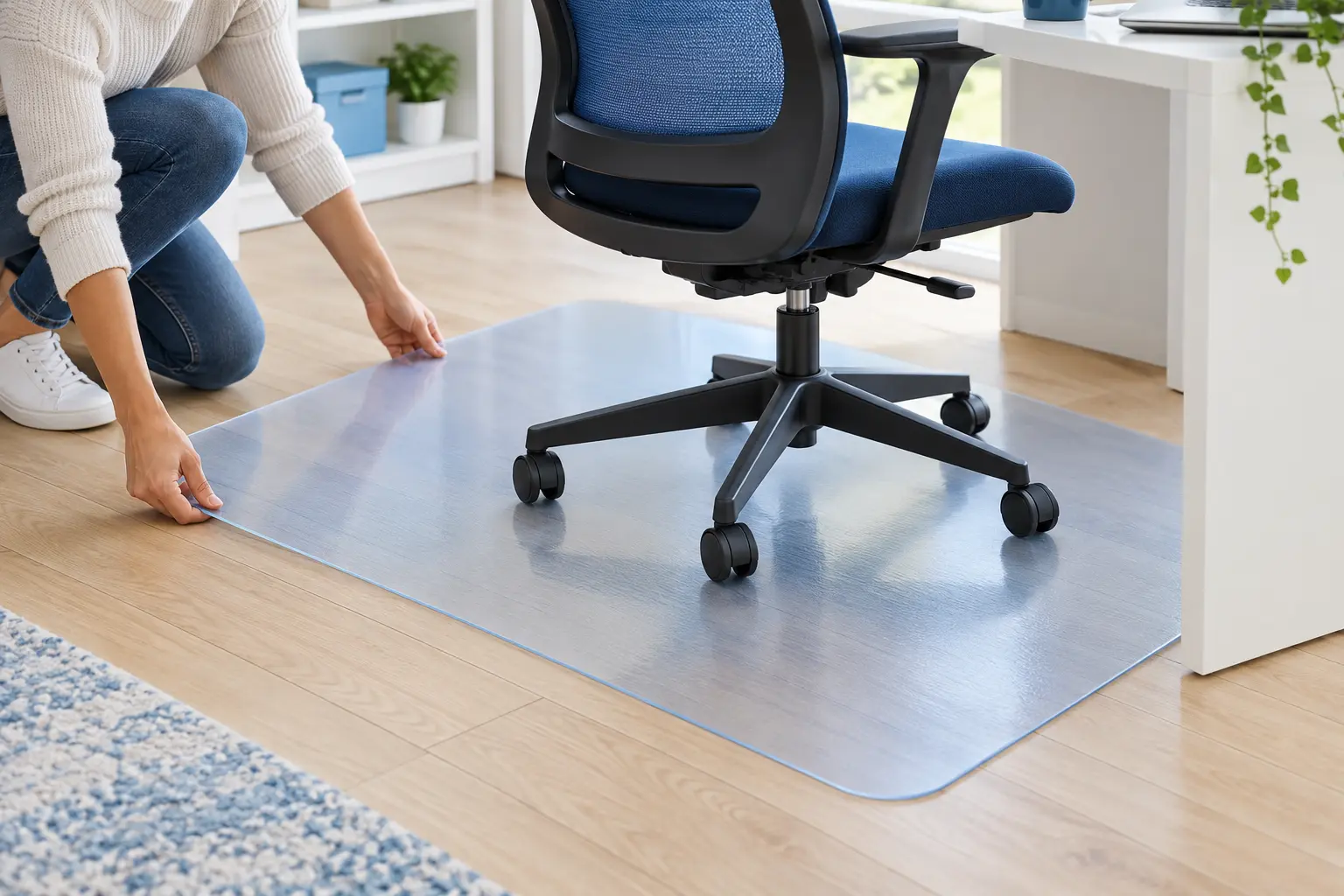
Best for wood, laminate, vinyl or tile when the floor maker permits a protective matA correctly sized mat places a replaceable barrier under the entire rolling zone. It can protect against routine caster contact and make trapped dirt easier to notice, but the backing and material must suit the exact floor finish.
- Benefits
- Creates one defined protected rolling zone
- Keeps the original chair wheels
- Can be lifted for inspection and cleaning
- Check before buying
- Identify the floor material and read its care or warranty guidance. Compare mat width, depth, lip position, edge profile, backing, discoloration warnings and whether the mat is explicitly intended for hard floors rather than carpet.
- Possible drawback
- A small, curling or incompatible mat can move, catch a caster, trap grit or react with a floor finish. Clear plastic may also show dust and pressure marks.
Carpet chair mat
Best when casters sink into carpet and the carpet construction is compatible with a matA carpet-specific mat spreads the chair's rolling contact across a larger area. Its underside and thickness are designed differently from a smooth hard-floor mat, so choosing by pile height matters.
- Benefits
- Defines a smoother chair zone on compatible carpet
- Reduces direct caster contact with carpet fibers
- Available for different desk and doorway layouts
- Check before buying
- Measure carpet pile and underlay, then compare the mat maker's carpet-depth range, backing style, total dimensions, edge shape and load guidance. Check the carpet manufacturer's care instructions before using a gripped or cleated backing.
- Possible drawback
- The wrong backing may mark carpet, while a mat that is too thin can flex or crack. Deep pile and soft underlay may need a product specifically rated for that construction.
Soft-tread dual-wheel casters
Best when the chair accepts replacement casters and a familiar compact wheel shape is preferredA purpose-made soft-tread caster can replace a hard or damaged wheel while keeping a similar dual-wheel format. The change addresses the contact point directly, but only when the stem, load and chair base are compatible.
- Benefits
- Targets hard or damaged wheel contact
- Keeps the floor visually uncovered
- Compact shape suits many chair bases
- Check before buying
- Use the chair maker's replacement specification where available. Confirm stem type and dimensions, total supported load, wheel diameter, floor suitability, installed height, clearance around the base and whether all casters must be replaced as a matching set.
- Possible drawback
- A universal-looking stem may not fit. A soft tread still carries grit, and mixed wheel sizes or an incorrect load rating can make the chair roll unevenly.
Large polyurethane single-wheel casters
Best for frequent rolling when the chair and desk allow a larger wheel and higher installed positionA larger wheel can roll over small surface transitions with less effort than a small caster. Polyurethane tread is commonly chosen for hard-floor contact, but material alone does not prove compatibility with every finish or chair.
- Benefits
- Larger diameter can cross small transitions more easily
- Open single-wheel form is often easier to inspect
- Replaces every old caster contact point
- Check before buying
- Confirm stem fit, wheel and swivel clearance, added seat height, desk clearance, total load rating, braking behavior and the exact floors listed by the maker. Replace the full set and test the chair slowly before normal use.
- Possible drawback
- Large wheels raise the chair and can contact the base or desk. Easier rolling may feel too fast on a smooth or sloped floor, and hair can still collect around axles.
Compatible stationary chair glides
Best when the chair does not need to roll and a fixed seating position is practicalGlides replace casters with stable feet, removing repeated wheel travel across the floor. They suit a workstation where the user can sit and stand without pulling the chair long distances.
- Benefits
- Stops routine caster travel
- Creates a predictable fixed chair position
- Can simplify a very small workstation
- Check before buying
- Confirm that the chair manufacturer allows glides and match the stem, installed height, base clearance and load. Check the glide's contact material for the floor and plan how the chair will be moved for cleaning without dragging it.
- Possible drawback
- The chair must be lifted or moved carefully rather than rolled. An incompatible or gritty glide can still mark the floor, and reduced movement will not suit every desk setup.
ProblemPick compares product types, not current offers. Amazon shows products, prices, ratings, availability and seller terms only after you choose to open a link.
Quick comparison: which protection fits the chair?
| Product type | Best use | Main limitation |
|---|---|---|
| Hard-floor chair mat | Best for wood, laminate, vinyl or tile when the floor maker permits a protective mat | A small, curling or incompatible mat can move, catch a caster, trap grit or react with a floor finish. Clear plastic may also show dust and pressure marks. |
| Carpet chair mat | Best when casters sink into carpet and the carpet construction is compatible with a mat | The wrong backing may mark carpet, while a mat that is too thin can flex or crack. Deep pile and soft underlay may need a product specifically rated for that construction. |
| Soft-tread dual-wheel casters | Best when the chair accepts replacement casters and a familiar compact wheel shape is preferred | A universal-looking stem may not fit. A soft tread still carries grit, and mixed wheel sizes or an incorrect load rating can make the chair roll unevenly. |
| Large polyurethane single-wheel casters | Best for frequent rolling when the chair and desk allow a larger wheel and higher installed position | Large wheels raise the chair and can contact the base or desk. Easier rolling may feel too fast on a smooth or sloped floor, and hair can still collect around axles. |
| Compatible stationary chair glides | Best when the chair does not need to roll and a fixed seating position is practical | The chair must be lifted or moved carefully rather than rolled. An incompatible or gritty glide can still mark the floor, and reduced movement will not suit every desk setup. |
What should you choose for each floor and movement pattern?
Is the hard floor intact but directly under the rolling path?
Use a hard-floor mat when its material and backing are approved for that finish. Size it from the real caster path and inspect beneath it regularly rather than treating it as a permanent sealed layer.
Does the chair sink or roll poorly on carpet?
Compare carpet mats by pile and underlay depth. Do not use a cleated carpet backing on hard flooring, and do not expect a thin mat to stay flat over deep, soft carpet.
Does one wheel feel rough or leave the same track?
Stop using the damaged caster and identify the maker-approved replacement specification. Replace the full set with compatible soft-tread wheels when the chair instructions and floor type allow it.
Do small thresholds interrupt frequent rolling?
Larger polyurethane casters may cross small transitions more smoothly, but check added height, swivel space and rolling speed. A mat may still be useful when dirt or finish compatibility remains the main concern.
Does the chair stay at one compact workstation?
Compatible stationary glides remove repeated rolling. Choose them only when sitting and standing remain practical without dragging the chair and when the chair maker permits the conversion.
How do you set up the protection and check it safely?
For the rest of the workstation, use the separate guide to improve a laptop desk setup in a small space. If the surface problem involves a loose rug rather than chair wheels, see how to keep an area rug from sliding. Browse more options in the Tech guide collection.
Office-chair floor-protection buying checklist
Office-chair floor-protection FAQs
Why is my office chair scratching the floor?
Frequent causes include grit embedded in a wheel, a cracked or rough caster, a wheel that no longer rotates freely, an exposed hard edge, or a protection mat that shifts and traps debris. Clean the area, inspect every contact point and identify the mark pattern before buying a solution.
Is a chair mat or soft caster better for hardwood floors?
A mat protects a defined area without changing the chair, while compatible soft casters change every rolling contact point and keep the floor visible. The better choice depends on the floor maker's guidance, the chair's caster specification, the size of the rolling zone and whether you want a visible barrier.
Can I use a carpet chair mat on a hard floor?
Only if the product explicitly lists that use. Carpet mats may have grips or cleats and a backing designed for pile, while hard-floor mats usually need a smooth, floor-compatible underside. Buy for the actual surface rather than flipping or repurposing a mat.
Do rollerblade-style office-chair wheels fit every chair?
No. Stem style and dimensions, wheel clearance, installed height and load rating vary. Check the chair maker's replacement information and the wheel seller's complete compatibility measurements before removing the original set.
How large should an office-chair mat be?
Measure the chair's real movement during work, including the path used to sit down and stand up. All casters should remain on the mat during normal use, with extra room before every edge. Also check the desk opening, nearby doors and any floor transition.
How often should I clean the chair wheels and floor protector?
Inspect them whenever rolling feels rough, debris becomes visible or marks appear. Clean using methods approved for the wheel, mat and floor, and check beneath a mat regularly so trapped grit or moisture does not remain hidden.