 ProblemPick
How to Stop a Kitchen Trash Can From Smelling
Find where the odor starts before buying a deodorizer. Choose an easy-clean removable bucket for trapped residue, a lid filter for ordinary odor between emptying, a separate food-scrap caddy for damp waste, fitted liners for leaks, or a dedicated brush for hard-to-reach seams.
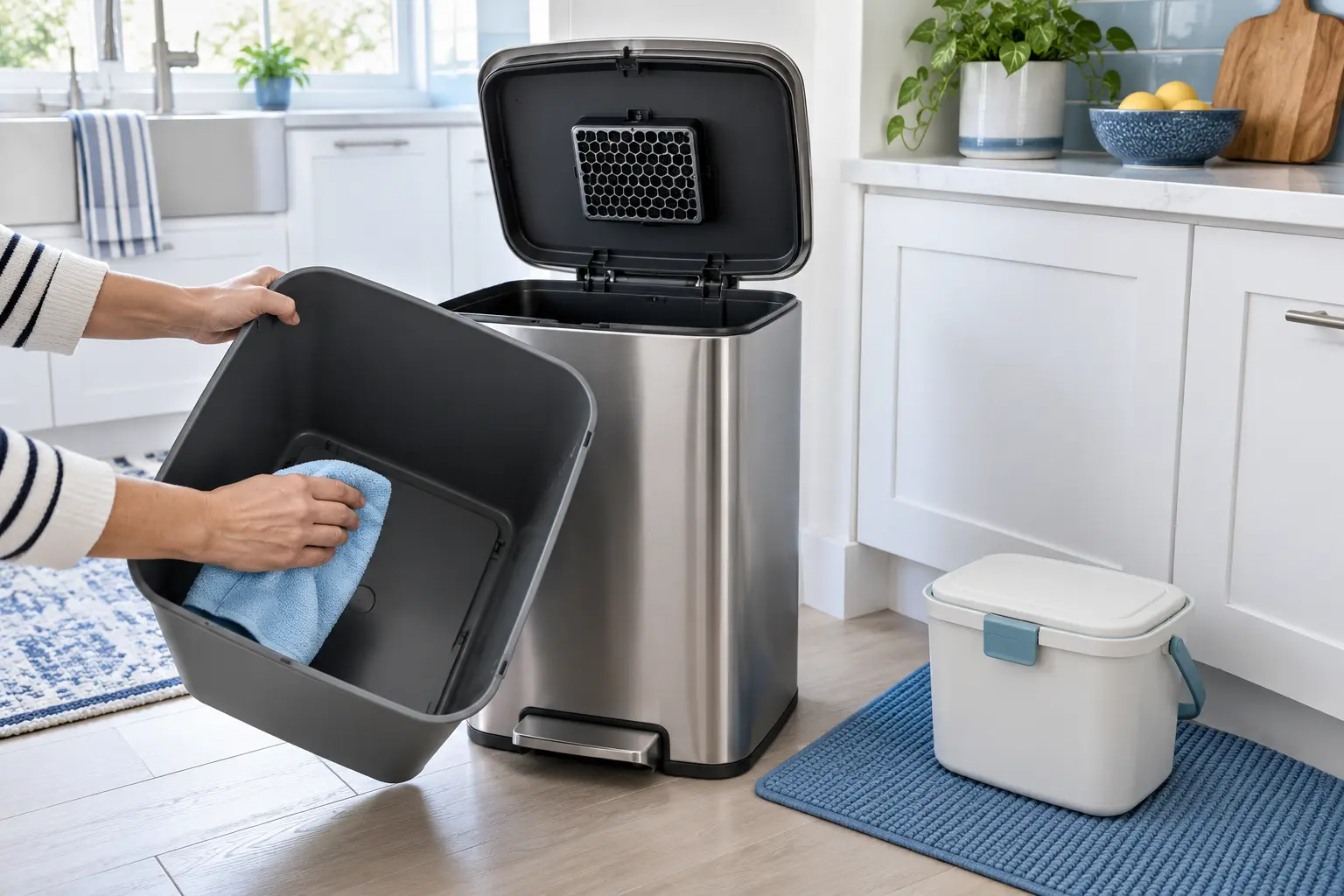
Clean safely: Follow the bin and cleaning-product instructions, unplug or isolate powered sensor parts as directed, and never immerse components that must stay dry. Do not mix cleaners. This guide covers routine household waste odor; it does not replace local rules for sharp, hazardous, hot or prohibited waste.
Why does the kitchen trash can still smell?
Separate odor inside the container from odor around it. Lift out the bag and look for a damp ring underneath, drips down the wall, residue caught beneath the rim, material around the hinge or a spill on the floor. A scented insert cannot solve contamination that is still present.
Next, note when the smell appears. Odor that begins after one type of wet waste points toward separation or a shorter emptying cycle. Odor that returns only when the lid stays closed may suit a compatible filter after cleaning. A permanently smelly empty bin may be scratched, cracked or difficult to reach.
Check the room too. A cabinet, nearby recycling container, food-scrap caddy, floor mat or plumbing area can be the actual source. Move and inspect one item at a time rather than applying several scented products that make the origin harder to identify.
What should you check before buying an odor-control product?
Measure the full open-lid height, not only the closed bin. Under a counter, the lid may strike a shelf before the inner bucket can be removed. For pull-out cabinets, include the rails, handles and clearance needed to tie and lift a bag.
Which products help with a smelly kitchen trash can?
Smooth-wall trash can with a removable inner bucket
Best when the current bin has deep seams, cracks or a fixed interior that is difficult to wash and dryA removable bucket lets you carry the empty interior to a suitable cleaning area without moving the full outer housing. Smooth corners and fewer narrow channels make residue easier to see, reach and remove.
- Benefits
- Interior can be removed for closer inspection
- Smooth surfaces expose drips and residue
- Outer housing can remain in position
- Check before buying
- Measure the cabinet or floor space, lid clearance and bag size. Lift the empty bucket before buying to judge the handle and balance. If the bin has a sensor, pedal or soft-close mechanism, confirm which parts can be removed or washed and which must stay dry.
- Possible drawback
- A second bucket adds weight and reduces usable capacity. A tight lid can contain ordinary odor, but it cannot compensate for liquid trapped below the liner or residue in the hinge and rim.
Replaceable activated-carbon lid filter
Best when the bin is already clean but ordinary food-waste odor builds between scheduled emptyingA filter mounted in a compatible lid adds a replaceable odor-control layer without taking floor space. It is most useful after leaks and residue have been removed and the lid can still close correctly.
- Benefits
- Fits inside a compatible lid
- Uses no cabinet or floor space
- Replacement is easy to schedule and inspect
- Check before buying
- Confirm the holder dimensions, airflow orientation and replacement instructions. Check whether the filter is supplied as a cut-to-fit sheet or a fitted cartridge, and keep it away from wet waste unless the maker specifically allows moisture exposure.
- Possible drawback
- A filter has limited capacity and becomes another consumable. It does not clean the bin, stop a leaking bag or fix a lid that no longer closes.
Sealed countertop food-scrap caddy
Best when peelings, coffee grounds or other damp food scraps create most of the odor in a large mixed-waste binA small separate caddy keeps a concentrated wet waste stream out of the main bin. Its shorter emptying cycle and removable lid can make the odor source easier to manage without changing the whole kitchen setup.
- Benefits
- Separates a common damp odor source
- Small size is easier to carry and empty
- Can sit near the food-preparation zone
- Check before buying
- Choose capacity from the amount produced before your normal collection or disposal routine, not from countertop appearance alone. Check lid removal, carry handle, dishwasher or hand-wash instructions, filter availability and the rules for food-waste collection where you live.
- Possible drawback
- It occupies counter or under-sink space and needs its own cleaning routine. A sealed caddy can still smell when opened, and it may be unnecessary if local collection or household habits do not separate food scraps.
Correct-size leak-resistant trash liners
Best when the bag slips, stretches around the rim or allows liquid to reach the bottom of the binA liner sized for the container stays closer to the walls and rim, reducing folds where wet waste can collect. Strong seams and a secure drawstring can make removal more controlled when the bag is not overfilled.
- Benefits
- Reduces loose folds inside the bin
- Can keep small drips away from the bucket
- Secure closure helps during removal
- Check before buying
- Use the bin maker's liner dimensions or measure circumference, height and base shape. Check seam construction, tie style and compatibility with local waste rules. Do not rely on a bag claim to contain sharp or prohibited waste.
- Possible drawback
- No flexible liner is a permanent leak barrier. Overfilling, sharp packaging and incorrect sizing can still tear it, and the bin must still be inspected beneath every changed bag.
Long-handled bin-cleaning brush
Best when residue remains around the base, rim or molded corners that a cloth cannot reach comfortablyA dedicated brush gives controlled reach inside an empty bucket while keeping the cleaning tool separate from dishes and food-preparation equipment. A removable or open brush head is easier to rinse and dry after use.
- Benefits
- Reaches deep bases and molded corners
- Keeps the task-specific tool separate
- Reusable head can be inspected before storage
- Check before buying
- Match the handle length to the bin depth and choose bristles approved for its surface. Check whether the head can be replaced, how it dries and where it will be stored. Follow the cleaner label and never mix cleaning products.
- Possible drawback
- Stiff bristles can scratch some finishes, while a dense head can retain moisture or debris. The brush itself becomes an odor source if it is not rinsed and dried as directed.
ProblemPick compares product types, not current offers. Amazon shows products, prices, ratings, availability and seller terms only after you choose to open a link.
Quick comparison: which odor-control option fits?
| Product type | Best use | Main limitation |
|---|---|---|
| Smooth-wall trash can with a removable inner bucket | Best when the current bin has deep seams, cracks or a fixed interior that is difficult to wash and dry | A second bucket adds weight and reduces usable capacity. A tight lid can contain ordinary odor, but it cannot compensate for liquid trapped below the liner or residue in the hinge and rim. |
| Replaceable activated-carbon lid filter | Best when the bin is already clean but ordinary food-waste odor builds between scheduled emptying | A filter has limited capacity and becomes another consumable. It does not clean the bin, stop a leaking bag or fix a lid that no longer closes. |
| Sealed countertop food-scrap caddy | Best when peelings, coffee grounds or other damp food scraps create most of the odor in a large mixed-waste bin | It occupies counter or under-sink space and needs its own cleaning routine. A sealed caddy can still smell when opened, and it may be unnecessary if local collection or household habits do not separate food scraps. |
| Correct-size leak-resistant trash liners | Best when the bag slips, stretches around the rim or allows liquid to reach the bottom of the bin | No flexible liner is a permanent leak barrier. Overfilling, sharp packaging and incorrect sizing can still tear it, and the bin must still be inspected beneath every changed bag. |
| Long-handled bin-cleaning brush | Best when residue remains around the base, rim or molded corners that a cloth cannot reach comfortably | Stiff bristles can scratch some finishes, while a dense head can retain moisture or debris. The brush itself becomes an odor source if it is not rinsed and dried as directed. |
Which option matches the way your bin smells?
Does residue remain after every bag change?
Prioritize cleanability. A removable smooth-wall bucket and a dedicated brush make the source visible and reachable. A filter should come only after the interior is clean and dry.
Is the bin clean but smells before collection day?
Use a lid filter designed for the holder and keep its replacement schedule visible. Recheck the base when the smell changes suddenly because a filter cannot contain a new leak.
Do damp food scraps cause most of the odor?
A small sealed caddy gives that waste a separate, easier-to-empty container. Choose its size from your real routine and local collection method, not from the largest model that fits the counter.
Does liquid reach the bottom of the bin?
Correct the liner fit and avoid stretching or overfilling it. Inspect beneath every changed bag; even a leak-resistant liner is not a washable bucket.
Is the smell strongest around the cabinet or floor?
Move the bin and inspect the surrounding surface, mat and neighboring containers. Buying a stronger deodorizer for the lid will not solve a spill outside the bin.
How do you set up a cleaner trash-bin routine?
For a better-organized cleaning zone, use the separate guide to store cleaning supplies in a small home. If cabinets and containers are the broader problem, compare ways to organize food-storage containers and lids. Browse more Kitchen guides or Home guides.
Kitchen trash-can buying checklist
Kitchen trash-can odor FAQs
Why does my trash can smell even after I empty it?
Liquid may be trapped below the liner, residue may remain on the rim or hinge, or the plastic may hold odor after repeated leaks. Remove the empty bucket when possible, inspect the base and lid closely, and clean only by the bin and cleaning-product instructions before adding any deodorizing product.
Does an activated-carbon filter stop trash can odors?
It can help with ordinary odor between emptying when the bin is already clean and the lid has a compatible holder. A filter will not stop a leaking bag, remove residue or repair a lid that no longer closes. Replace it on the maker's schedule and sooner if it becomes wet or damaged.
What kind of kitchen trash can is easiest to keep clean?
Look for a removable inner bucket, smooth walls, rounded interior corners and a lid or hinge you can inspect without tools. Check how sensor, pedal and soft-close parts must be protected during cleaning. The easiest choice is the one you can fully empty, reach and dry in your available space.
Should I replace a plastic trash can that still smells?
Replacement can make sense when the surface is cracked, deeply scratched, deformed or still retains odor after instruction-based cleaning and complete drying. First check removable parts, the lid seal and the floor or cabinet around the bin so a nearby spill is not mistaken for odor from the container.
Can I keep a kitchen trash can inside a cabinet?
Only if the bin fits with enough clearance for its lid, handle and bag removal, and the cabinet remains easy to inspect for leaks. Do not let the bin block plumbing access or press against heat-producing equipment. Measure the opening and the full lid path before buying.
How often should I clean the kitchen trash can?
Use the bin maker's care instructions and clean promptly after a leak, torn bag or visible residue. Between those events, inspect the rim, lid, base and area beneath each time the liner is changed. A fixed universal schedule is less useful than responding to what the bin actually contains and how often it is emptied.