 ProblemPick
Tablecloth Keeps Sliding? Try These Fixes
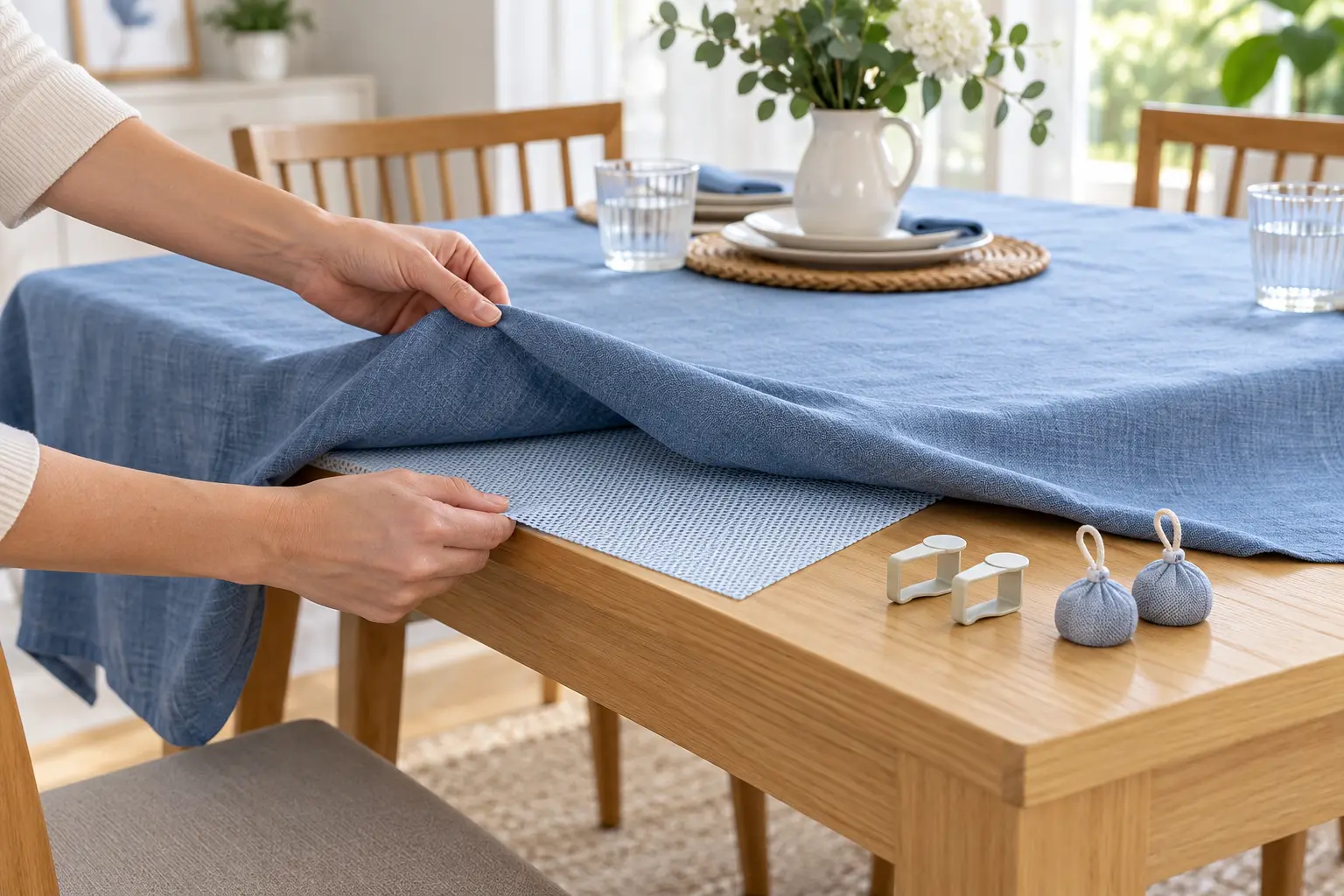
First center the cloth on a clean, dry table and balance the overhang. If it still moves, use a thin reusable nonslip underlay for broad indoor grip, removable clips for an accessible edge, corner weights for light outdoor lift, a fitted cover for a busy table, or a padded protector when the surface also needs cushioning.
Protect the table: Follow the furniture and tablecloth care instructions. Test a contact material in an inconspicuous place, remove grit before fitting it and keep trapped moisture, high heat and permanent adhesive away from finishes that do not explicitly allow them.
Why does the tablecloth move?
Start with the contact between cloth and table. Smooth glass, sealed wood and laminate offer different grip, while polish, crumbs or a damp film can make any surface less predictable. A very light synthetic cloth usually has less weight resisting a pull than a heavy woven one.
Check the overhang next. If one side hangs much lower, gravity and repeated contact can draw the cloth in that direction. Chairs, sleeves, children doing crafts and serving dishes near an edge can also create small pulls that accumulate during a meal.
Outdoors, separate sliding from lifting. Air can catch the loose corners even when the center has enough grip. That calls for edge restraint or weight rather than a thicker layer under the whole table.
What should you measure before buying a tablecloth grip?
Use the narrowest real clearance and the maker's supported size range. A clip that opens wide enough can still be wrong if its body collides with an apron or sits where a person's knee meets the table.
Which products can stop a tablecloth from sliding?
Reusable nonslip tablecloth underlay
Best for indoor wood, laminate or glass tables when the cloth slides as one flat sheetA thin silicone, felt-backed or mesh layer increases friction across a broad area without fastening the cloth to the table. It is easy to hide because the underlay can be cut or chosen slightly smaller than the tabletop.
- Benefits
- Adds grip across most of the tabletop
- Stays hidden below the cloth
- Removes for cleaning or a bare-table setup
- Check before buying
- Measure the flat tabletop inside the edges. Check the maker's finish-compatibility, washability, thickness, heat limits and whether the material may transfer color or leave a temporary texture on a soft finish.
- Possible drawback
- It adds a layer to align and clean, and some materials can hold moisture or imprint on delicate finishes. A thick underlay may make glasses or place settings less stable.
Removable tablecloth clips
Best for outdoor tables or everyday tables with an accessible, regular edgeClips grip the cloth at several points around the perimeter, so a breeze or a pull cannot move the whole cover as easily. They work without covering the center of the table.
- Benefits
- Quick to install and remove
- Useful against edge lift outdoors
- No extra layer under place settings
- Check before buying
- Measure tabletop thickness at the exact attachment points and note any bevel, apron, rail or rounded edge. Check the clip opening, contact pads, rust resistance and the clearance needed for knees, chairs and table leaves.
- Possible drawback
- Clips remain visible, may not fit thick or irregular edges and can interfere with seating. Excess pressure or a sharp contact point can mark a delicate cloth or table finish.
Fabric-covered corner weights
Best for a lightweight outdoor cloth that lifts at the corners but does not slide across the centerSmall weights add downward tension at the hanging corners. They can calm local flutter while preserving a loose drape and avoiding hardware on the table edge.
- Benefits
- Keeps a soft draped appearance
- Stores in very little space
- Targets corners that lift in a light breeze
- Check before buying
- Count usable corners, measure the overhang and check the attachment method, weight per piece, fabric-care instructions and whether the cloth is strong enough to carry the load without stretching.
- Possible drawback
- Weights do little when the entire cloth slides, and they can pull or crease fine fabric. Detachable parts must be removed before laundering and stored together when not in use.
Fitted or elastic-edged table cover
Best for busy round or rectangular tables where a fixed shape matters more than a traditional overhangAn elastic edge wraps below the tabletop and holds the cover around its full perimeter. This is useful for craft, play, buffet or patio tables where people repeatedly brush against the edges.
- Benefits
- Grips around the full perimeter
- No loose corners to catch
- Fast to reset for frequent use
- Check before buying
- Measure length, width or diameter, tabletop thickness and corner radius. Confirm the supported shape and size range, elastic access around the underside, care method and clearance from folding or extension mechanisms.
- Possible drawback
- The fitted look is less formal and size tolerance is limited. Elastic can fatigue, and the cover may not fit tables with a deep apron, attached leaves or an irregular top.
Padded table protector
Best when the table also needs a cushioned protective layer beneath a decorative clothA felt-backed or padded protector can add friction while buffering light everyday contact. It creates a more substantial base than a thin mesh underlay and may soften the sound of tableware.
- Benefits
- Combines grip with a protective layer
- Can soften contact noise
- Supports a smoother cloth drape
- Check before buying
- Measure the flat top precisely and check finish compatibility, thickness, heat and moisture limits, cleaning instructions and whether the protector must be removed between uses.
- Possible drawback
- It is bulkier to store and can trap moisture or warmth against the table. It is not a substitute for trivets or the furniture maker's heat and care guidance.
ProblemPick compares product types, not current offers. Amazon shows products, prices, ratings, availability and seller terms only after you choose to open a link.
Quick comparison: which tablecloth holder fits?
| Product type | Best use | Main limitation |
|---|---|---|
| Reusable nonslip tablecloth underlay | Best for indoor wood, laminate or glass tables when the cloth slides as one flat sheet | It adds a layer to align and clean, and some materials can hold moisture or imprint on delicate finishes. A thick underlay may make glasses or place settings less stable. |
| Removable tablecloth clips | Best for outdoor tables or everyday tables with an accessible, regular edge | Clips remain visible, may not fit thick or irregular edges and can interfere with seating. Excess pressure or a sharp contact point can mark a delicate cloth or table finish. |
| Fabric-covered corner weights | Best for a lightweight outdoor cloth that lifts at the corners but does not slide across the center | Weights do little when the entire cloth slides, and they can pull or crease fine fabric. Detachable parts must be removed before laundering and stored together when not in use. |
| Fitted or elastic-edged table cover | Best for busy round or rectangular tables where a fixed shape matters more than a traditional overhang | The fitted look is less formal and size tolerance is limited. Elastic can fatigue, and the cover may not fit tables with a deep apron, attached leaves or an irregular top. |
| Padded table protector | Best when the table also needs a cushioned protective layer beneath a decorative cloth | It is bulkier to store and can trap moisture or warmth against the table. It is not a substitute for trivets or the furniture maker's heat and care guidance. |
Which option suits the way the cloth moves?
Does the whole cloth drift on a smooth indoor table?
Choose a thin removable underlay. It spreads grip broadly and remains hidden, but confirm compatibility with the table finish and keep the layer flat and dry.
Does a breeze lift the outdoor edges?
Use clips if the table has a regular accessible edge. Use corner weights when you want to preserve the drape and only the corners flutter.
Do people repeatedly catch the overhang?
A fitted elastic-edged cover removes loose corners and is easy to reset. Measure the exact shape, thickness and underside access first.
Does the table also need a protective layer?
A padded protector can combine friction and cushioning. Check heat and moisture limits, and do not leave it trapped against a finish longer than its instructions allow.
Is the cloth simply off-center?
Rebalance the drop before buying anything. A level overhang reduces the continuous pull from one heavy side and makes every added holder work more evenly.
How do you set up a tablecloth so it stays put?
If a small dining area is also hard to reset, use our small-kitchen organization guide. For a cleaner counter workflow, compare food-container and lid organizers. Browse more Home and Kitchen guides.
Tablecloth grip buying checklist
Tablecloth grip FAQs
Why does my tablecloth keep sliding?
A very smooth table, a light cloth, an uneven overhang, cleaning residue or repeated contact from people and chairs can reduce stability. Center the cloth on a clean, dry surface and watch whether the whole cloth moves or only the corners lift.
How can I stop a tablecloth moving without adhesive?
Use a removable nonslip underlay, correctly sized clips, corner weights, a fitted cover or a padded protector. Choose by table finish, edge shape, cloth weight and whether the problem happens indoors or outdoors.
Can I use shelf liner under a tablecloth?
Only when its maker allows contact with the table finish and it lies flat without transferring color or texture. A purpose-made washable tablecloth underlay is easier to evaluate for repeated use on furniture.
Do tablecloth clips damage the table or cloth?
A well-fitted clip with smooth padded contact points should not need excessive force, but no clip is suitable for every edge or finish. Measure first, inspect for sharp points and test one inconspicuous location before fitting the full set.
What works best on a glass table?
A thin washable nonslip underlay often adds broad grip while remaining hidden. Check that it is suitable for glass, keep both surfaces free of grit and moisture, and avoid any product that leaves the tableware unstable.
Why does an outdoor tablecloth lift even when it does not slide?
Air catches the overhang and corners before the center moves. Clips or corner weights can control that edge lift, but bring the cloth indoors in stronger weather and keep table openings, umbrellas and folding parts unobstructed.