 ProblemPick
Laundry Basket Taking Up Too Much Space? Try These Options
Measure the collection spot, the filled load and the route to the washer before buying. Choose a slim hamper for a narrow gap, a corner shape for unused floor, a hanging bag when the door allows it, a collapsible hamper for temporary use or a rolling sorter when separation matters.
Collection, not drying: This guide is for ordinary dry, washable household laundry waiting for its next wash. Keep damp items separate and follow each garment's care instructions. Do not place a hamper against heaters, vents, electrical equipment or any route that must remain clear.
Why does the laundry basket feel too large?
The outside dimensions may be wrong for the room, but placement and routine matter just as much. A round basket wastes a straight gap, a rigid lid cannot open under a shelf, a bag bulges beyond its listed width and a large hamper stays in the walkway because it is too awkward to carry when full.
Watch one normal laundry cycle before replacing anything. Note where clothes are removed, where they first land, how often the load moves to the washer and whether sorting happens at collection time or beside the machine. A hamper in the wrong room creates floor piles even when it is technically compact.
Separate this from drying. Damp towels or exercise wear may need to air according to their care guidance before joining ordinary dry laundry. The separate guide on drying laundry in a small apartment covers wet clean loads after washing.
What should you measure before choosing a compact hamper?
Mark the proposed footprint with removable paper or low-risk markers approved for the surface, then walk the route and operate every nearby door. This reveals a conflict before a container occupies the room.
Which laundry hamper types save space?
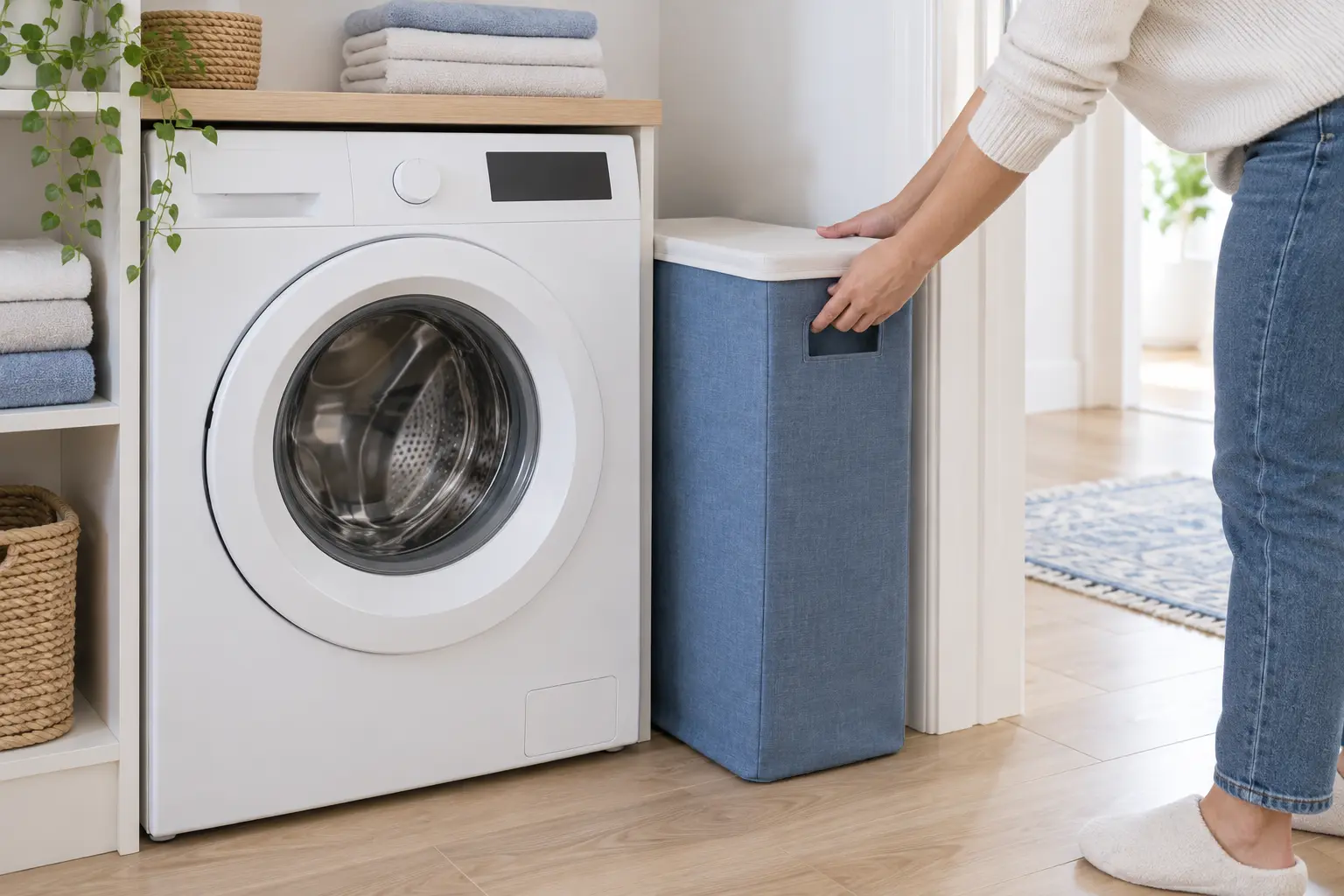
Slim upright hamper
Best for a narrow gap beside a washer, wardrobe or bathroom cabinetA tall hamper uses height instead of a wide footprint. A fitted lid can hide the contents, while a removable inner bag makes the load easier to carry without moving the whole frame.
- Benefits
- Uses a narrow strip of floor
- Keeps one collection point visible
- Removable liners can simplify carrying
- Check before buying
- Measure the narrowest width and depth at floor, middle and top height. Include the lid swing, handles, base feet and the space needed to pull out a liner. Compare usable capacity rather than exterior height alone.
- Possible drawback
- A very narrow hamper can tip when pulled from the top, and a hinged lid or rigid frame may need more clearance than the product width suggests.
Corner laundry hamper
Best when an unused room corner is available but no straight gap is wide enoughA triangular or curved-back hamper turns an awkward corner into a collection point. It can leave the middle of a bathroom or bedroom clearer than a rectangular basket placed diagonally.
- Benefits
- Uses an otherwise awkward corner
- Keeps the central walkway clearer
- Available with removable carrying bags
- Check before buying
- Measure both wall runs, the diagonal front edge and any skirting board. Check whether the lid, liner and carrying handles can be reached without moving nearby furniture or blocking a door.
- Possible drawback
- The angled shape may hold less than a rectangular hamper with similar outside dimensions, and a deep back corner can be difficult to empty or clean.
Over-door hanging laundry bag
Best when floor space is unavailable and a compatible door can carry the loaded bagA hanging bag moves dirty laundry onto unused vertical space. A lower zipper or wide opening can make unloading easier, and removable hooks let the system move with the routine.
- Benefits
- Preserves floor space
- Can lift off for the trip to the washer
- Keeps the bag in a consistent location
- Check before buying
- Confirm the door material, thickness, top gap, hinge clearance and permitted load. Measure the full bag when filled so it does not hit a handle, wall, radiator or floor, and make sure the door still opens and closes normally.
- Possible drawback
- A loaded bag can swing, make a door harder to use or mark its finish. Over-door hooks may prevent a tight door from closing and are unsuitable when the maker forbids added weight.
Collapsible pop-up hamper
Best for temporary collection when the container must disappear after laundry dayA lightweight folding hamper can open only when a load is building and store flat or compactly when empty. It suits guest rooms, shared spaces or a routine that moves laundry frequently.
- Benefits
- Stores compactly when empty
- Light to carry between rooms
- Useful for temporary or shared spaces
- Check before buying
- Compare open and folded dimensions, the folding method, handles, fabric structure and stated load. Check that the frame is fully enclosed and that the hamper stands steadily when partly filled.
- Possible drawback
- Soft sides can collapse around the opening, a spring frame can be awkward to fold, and lightweight models may tip or drag when heavily filled.
Narrow rolling laundry sorter
Best on one level when laundry should be separated before it reaches the washerA slim frame with two or more removable bags can collect light and dark loads in one vertical station. Casters help move it across a smooth route without carrying the complete frame.
- Benefits
- Sorts laundry at the collection point
- Moves across a compatible level floor
- Removable bags can travel separately
- Check before buying
- Measure the full frame, loaded bag bulge, caster height, handle and turning space. Check wheel locks, floor suitability, bag removal direction and the entire route to the washer, including thresholds and doors.
- Possible drawback
- The frame needs turning room and can roll or tip if overloaded. Small casters may catch at thresholds, and a wheeled sorter is not a solution for stairs.
ProblemPick compares product types, not current offers. Amazon shows products, prices, ratings, availability and seller terms only after you choose to open a link.
Quick comparison: which compact hamper fits?
| Product type | Best use | Main limitation |
|---|---|---|
| Slim upright hamper | Best for a narrow gap beside a washer, wardrobe or bathroom cabinet | A very narrow hamper can tip when pulled from the top, and a hinged lid or rigid frame may need more clearance than the product width suggests. |
| Corner laundry hamper | Best when an unused room corner is available but no straight gap is wide enough | The angled shape may hold less than a rectangular hamper with similar outside dimensions, and a deep back corner can be difficult to empty or clean. |
| Over-door hanging laundry bag | Best when floor space is unavailable and a compatible door can carry the loaded bag | A loaded bag can swing, make a door harder to use or mark its finish. Over-door hooks may prevent a tight door from closing and are unsuitable when the maker forbids added weight. |
| Collapsible pop-up hamper | Best for temporary collection when the container must disappear after laundry day | Soft sides can collapse around the opening, a spring frame can be awkward to fold, and lightweight models may tip or drag when heavily filled. |
| Narrow rolling laundry sorter | Best on one level when laundry should be separated before it reaches the washer | The frame needs turning room and can roll or tip if overloaded. Small casters may catch at thresholds, and a wheeled sorter is not a solution for stairs. |
Which option suits your room and routine?
Is there a narrow straight gap beside furniture or the washer?
Start with a slim upright hamper. Check the whole height and allow room for the liner and lid; a basket that fits only while empty is not a fit.
Is the only spare floor an awkward corner?
Compare a corner hamper with a slim rectangular one placed along either wall. Choose the shape that leaves a usable opening and does not hide behind a door.
Is every part of the floor already needed?
Consider an over-door bag only after checking door clearance, finish and load. It should not make the door harder to operate or swing into people and furniture.
Does the container need to vanish between loads?
A collapsible hamper suits frequent emptying and temporary use. Practice the folding action and check that the open frame remains stable before relying on it every day.
Do mixed loads create repeated sorting piles?
A narrow rolling sorter can combine collection and separation when the route is level and wide enough. If it must climb stairs, use removable bags rather than moving the loaded frame.
How do you keep a compact laundry station usable?
If cleaning products share the area, keep them in their own appropriate storage and use the guide to organize cleaning supplies in a small home. If bath towels stay damp between uses, diagnose whether the towel holder, room moisture or fabric is the real bottleneck. For cramped bathrooms, the small-bathroom storage guide compares separate removable organizers. Browse the Organization collection or more Home guides.
Small-space laundry hamper buying checklist
Small-space laundry hamper FAQs
What type of laundry basket is best for a small space?
Choose by the space you actually have. A slim upright hamper suits a narrow straight gap, a corner hamper uses an awkward corner, a hanging bag preserves the floor, a collapsible hamper stores away when empty, and a rolling sorter suits a level route with room to turn.
How do I measure for a slim laundry hamper?
Measure width and depth at the floor, middle and top because walls, trim and furniture may not be straight. Record available height, lid movement, handle clearance, liner removal space and the narrowest point along the route to the washer.
Should a small laundry hamper have a lid?
A lid can make the collection point look calmer, but it adds opening clearance and can slow quick use. Compare the lid with ventilation, liner access and the way the hamper sits under a shelf or counter rather than choosing on appearance alone.
Can I hang a laundry bag over any door?
No. Check the door maker's guidance, material, thickness, top gap, hinges and load. The hook must not stop the door closing, damage the finish or create an obstruction, and the filled bag must stay clear of handles, heat sources and the floor.
Is a collapsible hamper practical for everyday laundry?
It can be when laundry moves frequently and the empty hamper is folded after each load. For a permanent collection point, test whether its opening stays accessible and its soft sides remain stable with only a few garments inside.
How many laundry hampers do I need in a small apartment?
Start with one collection point sized to the normal interval between washes. Add separation only when it prevents repeated floor piles or re-sorting and the containers still fit the measured space. Several half-used hampers can create more clutter than one clear routine.