 ProblemPick
Pot Lids Cluttering the Cabinet? Try These Organizers
Start with an adjustable rack when you need a flexible, no-drill fix. Choose a drawer tray for top-down access, a door holder to reclaim shelf space, a pull-out for a deep cabinet, or a properly mounted wall system when the cabinet is already full.
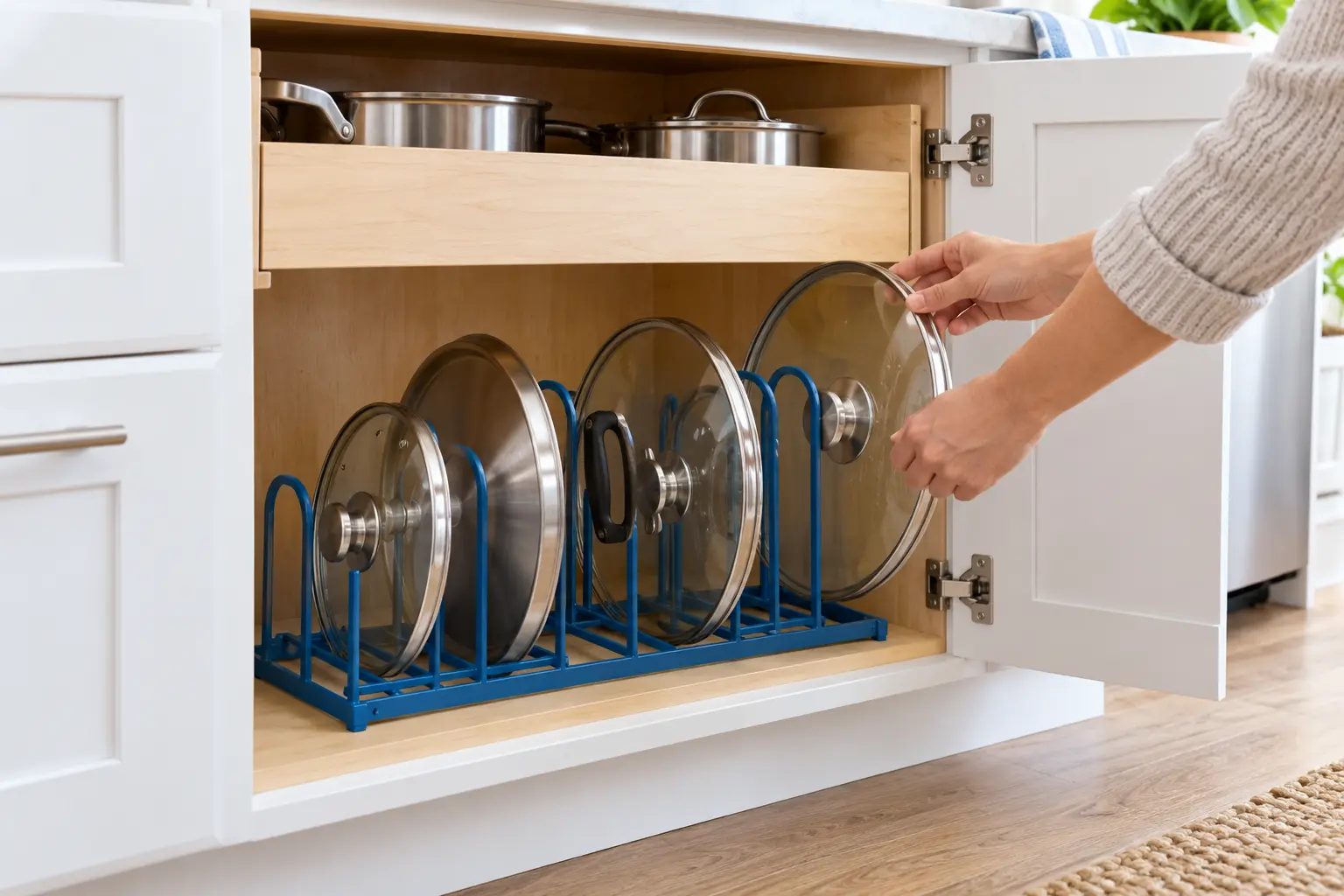
Protect glass and cabinet hardware: Do not balance lids loosely, overload a rack or attach heavy storage to an unsuitable door or wall. Follow the cookware, cabinet and organizer instructions, and keep glass edges where they cannot be struck.
Why do pot lids become a messy stack?
Lids are difficult to stack because their rims, knobs and handles create different heights. A horizontal pile becomes unstable, while lids leaning against pans can slide when one piece is removed. The cabinet may have enough volume but not enough defined slots.
Empty the space and group lids by diameter. Remove duplicates or lids that belong elsewhere, then identify the two or three used most often. If those daily lids are trapped behind occasional pieces, access—not total capacity—is the main problem.
This guide covers cookware lids. For the cookware itself, see how to store pans without scratching. Thin plastic food-container lids need a different layout, covered in the container-and-lid organization guide.
What should you measure before buying a lid organizer?
Make a cardboard outline of the organizer base or door holder. Place the largest lid inside it, close the door and open adjacent drawers before ordering.
Which products organize pot lids effectively?
Adjustable freestanding lid rack
Best for renters and mixed lid sizes in a cabinetMovable dividers create narrow slots for flat lids and wider slots for deep rims or large knobs. The rack can move with the cookware and needs no permanent installation.
- Benefits
- Spacing adapts to different lids
- No drilling required
- Each lid stays visible
- Check before buying
- Measure clear cabinet width, depth and height, then compare the rack's base, divider spacing and tipping resistance. Test the widest rim and tallest knob rather than relying only on lid diameter.
- Possible drawback
- The frame uses some shelf area, and a light rack can shift or tip when a heavy lid is removed from one side.
Low-profile drawer lid tray
Best for a deep drawer with enough height below the counterA shallow slotted tray stores lids upright or at a slight angle while keeping knobs below the drawer opening. Pulling out the drawer makes every lid easy to see from above.
- Benefits
- Full collection visible from above
- No cabinet-door hardware
- Good access without reaching low
- Check before buying
- Measure the drawer's internal width, depth and usable height at the lowest obstruction. Include the tallest knob, drawer sides and any pan handles sharing the space.
- Possible drawback
- It dedicates valuable drawer area to lids and can stop the drawer closing if a knob or rim sits too high.
Cabinet-door lid holder
Best for freeing a shelf when the door has usable inside spaceA purpose-built holder uses the otherwise empty inside face of a cabinet door. It keeps a small group of frequently used lids separate from pots and pans.
- Benefits
- Uses vertical door space
- Fast access to regular-use lids
- Leaves the shelf open
- Check before buying
- Confirm the door material, panel thickness, hinge capacity, mounting method and closed-door clearance. Map shelves, knobs and cookware with the door shut before attaching anything.
- Possible drawback
- It may not suit thin or framed doors, heavy lids or shallow cabinets, and poor placement can make lids hit shelves or cookware.
Pull-out lid organizer
Best for a deep lower cabinet where lids disappear at the backA sliding frame brings stored lids to the cabinet opening and keeps them in defined slots. It can make a low, deep cabinet easier to use without stacking lids horizontally.
- Benefits
- Brings rear lids forward
- Defined slot for each lid
- Useful in deep base cabinets
- Check before buying
- Measure the clear opening after hinges and face frames, the full cabinet depth and the installation footprint. Compare total lid weight with the stated load and confirm the slide can extend without blocking nearby doors.
- Possible drawback
- It costs more, consumes cabinet volume and normally needs secure installation in a compatible cabinet.
Wall rail or pegboard lid system
Best when cabinet space is full and suitable wall space is availableA purpose-built rail, bracket or pegboard arrangement stores compatible lids vertically outside the cabinet. Frequently used lids remain visible and do not lean against cookware.
- Benefits
- Frees cabinet and drawer space
- Individual access
- Layout can suit the lid collection
- Check before buying
- Verify the wall structure, fasteners, system load, lid-rim fit and clearance from heat, splashes and walkways. Keep glass lids where they cannot be bumped or fall.
- Possible drawback
- It is visible, collects kitchen dust and grease, and requires reliable mounting in an appropriate location.
ProblemPick compares product types, not current offers. Amazon shows products, prices, ratings, availability and seller terms only after you choose to open a link.
Quick comparison: which pot-lid organizer fits?
| Organizer type | Best use | Main limitation |
|---|---|---|
| Adjustable freestanding lid rack | Best for renters and mixed lid sizes in a cabinet | The frame uses some shelf area, and a light rack can shift or tip when a heavy lid is removed from one side. |
| Low-profile drawer lid tray | Best for a deep drawer with enough height below the counter | It dedicates valuable drawer area to lids and can stop the drawer closing if a knob or rim sits too high. |
| Cabinet-door lid holder | Best for freeing a shelf when the door has usable inside space | It may not suit thin or framed doors, heavy lids or shallow cabinets, and poor placement can make lids hit shelves or cookware. |
| Pull-out lid organizer | Best for a deep lower cabinet where lids disappear at the back | It costs more, consumes cabinet volume and normally needs secure installation in a compatible cabinet. |
| Wall rail or pegboard lid system | Best when cabinet space is full and suitable wall space is available | It is visible, collects kitchen dust and grease, and requires reliable mounting in an appropriate location. |
Which option suits your kitchen space?
Do you rent or want no permanent installation?
Start with a stable freestanding adjustable rack. It can adapt to several rim depths and move to another cabinet later.
Do you have a deep drawer below the worktop?
Choose a low-profile tray only after checking knob height. The drawer should close without pressing on glass, handles or the counter frame.
Is the shelf full but the door interior empty?
A door holder may reclaim space, but test closed-door clearance and verify that the door, hinges and attachment method suit the combined load.
Do lids disappear at the back of a low cabinet?
A pull-out can improve reach. Measure around face frames and hinges, and account for the installer's required mounting space.
Is every cabinet and drawer already committed?
Consider a wall rail or pegboard only in a suitable, securely mounted position away from heat, splashes and busy walkways.
How do you set up a pot-lid organizer?
For broader planning, see how to organize a small kitchen. Browse more Kitchen and Organization guides.
Pot-lid organizer buying checklist
Pot-lid storage FAQs
What is the best way to organize pot lids?
For most cabinets, a stable adjustable rack is the simplest starting point because it separates lids without permanent installation. A drawer tray improves top-down access, while a door holder or pull-out works only when measurements and cabinet construction allow it.
Should pot lids be stored vertically or flat?
Vertical storage usually makes individual lids easier to remove and avoids lifting a stack. Flat storage may fit a very shallow space, but use a stable layer and avoid placing heavy pieces on fragile glass lids or raised knobs.
How do I measure for a pot-lid organizer?
Measure clear width, depth and height inside the actual opening. Include hinges, face frames, shelf supports, lid rims and the tallest knob. For door storage, close the door against a cardboard mock-up before buying.
Can I store glass pot lids on a cabinet door?
Only when the holder, door and fasteners are intended for the combined size and weight, and the lids cannot strike a shelf or pan when the door closes. Follow the cabinet and organizer instructions and avoid an unstable or overloaded setup.
How many lids should one rack hold?
Use the organizer's stated capacity and load rather than filling every visible gap. Leave enough spacing to lift each lid by its rim or handle without scraping adjacent pieces or pulling the rack sideways.
Can the same organizer hold food-container lids?
It may, but cookware lids are heavier and usually have knobs or deep rims. A rack sized for pot lids is not automatically efficient for thin food-container lids, which are better grouped by container shape in a separate organizer.