 ProblemPick
Spices Taking Over the Kitchen? Try These Organizers
Use a low-profile insert for a compatible shallow drawer, a tiered shelf for cabinet visibility, a pull-out rack for narrow depth, a turntable for a corner or a divided handled bin for mixed jars and refill packets. Measure the largest container and the actual opening before buying.
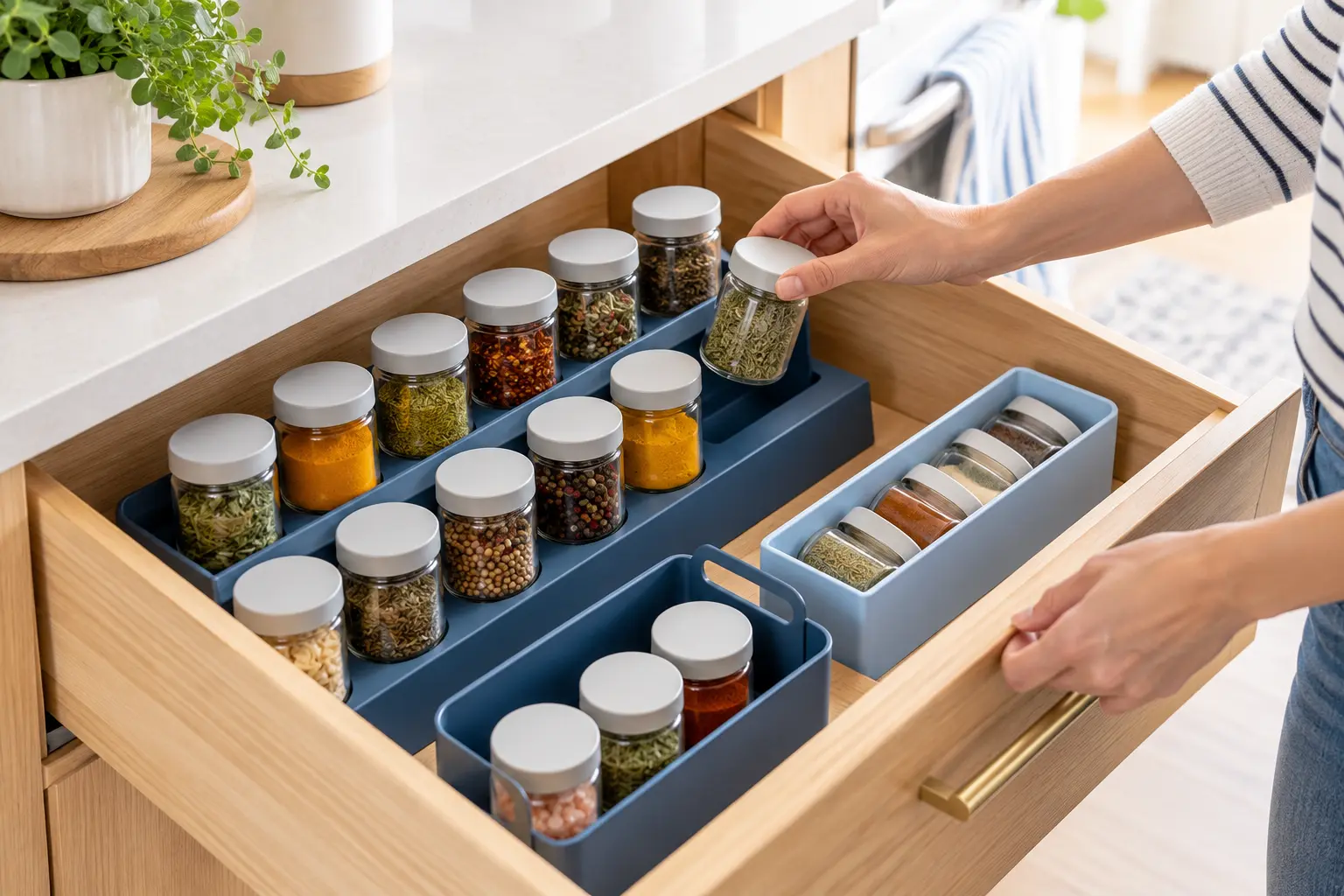
Protect the storage setup: Follow each package's storage directions and the organizer and cabinet instructions. Keep jars fully supported, do not overload shelves or slides, and place a loaded removable bin where it can be slid safely rather than lifted awkwardly overhead.
Why do spices become difficult to find?
Spices usually become frustrating when labels and access disappear, not simply when the collection is large. Small jars hide behind tall ones, refill packets fall into gaps and duplicate containers spread across several cabinets. The result is repeated searching and a counter that becomes overflow storage.
Gather the collection in one place, remove empty packaging and group by how you cook: everyday basics, baking, regional cuisines and occasional refills. Then identify the failure—hidden back rows, unused drawer space, a narrow deep cabinet, an awkward corner or too many container shapes.
If the whole room lacks usable zones, start with our small-kitchen storage guide. Canned goods need stronger organizers and a separate plan; see how to organize canned goods in a cabinet.
What should you measure before buying?
Make a cardboard footprint of the organizer and place the largest jars on it. Open the door or drawer fully and test the removal path before ordering.
Which spice organizers work in a small kitchen?
Low-profile drawer insert
Best for matching jars in a shallow drawer that can hold them securelyAngled or stepped channels keep labels visible from above and turn a whole drawer into one scanable spice zone. It suits cooks who want frequent spices beside the main preparation area without filling the counter.
- Benefits
- Labels stay visible from above
- Keeps the counter and cabinet shelves clear
- Frequent jars remain within one reach
- Check before buying
- Measure the drawer's clear internal width, depth and height below any rail or worktop. Compare every jar diameter and length with the channels, then confirm the loaded drawer can close without lids touching above.
- Possible drawback
- A dedicated insert consumes most of a drawer and may not fit square tins, refill packets or mixed jar diameters. Tall jars can prevent the drawer from closing.
Tiered cabinet shelf
Best for a shallow upper cabinet where the back row disappearsRaised rear levels expose more labels while keeping jars upright. A freestanding riser is easy to reposition when the collection changes and needs no permanent installation.
- Benefits
- Improves visibility across several rows
- Needs no permanent mounting
- Easy to reorganize by use or cuisine
- Check before buying
- Measure clear cabinet width, depth and loaded height, including the tallest jar on the highest step. Check step depth, jar-base support and a stable nonslip footprint.
- Possible drawback
- The steps use vertical space and shorten usable depth. Very small jars can still hide behind larger ones, and the rear row may be difficult to reach on a high shelf.
Pull-out spice rack
Best for a narrow, deep cabinet where jars are hidden behind one anotherA sliding frame brings the full row toward the cabinet opening. Side rails or baskets keep jars together while preserving a narrow footprint.
- Benefits
- Makes deep storage easier to reach
- Uses a narrow vertical zone
- Keeps jars in a consistent row
- Check before buying
- Measure the narrowest opening between hinges and frame, the usable depth and the mounting surface. Compare jar heights and diameters with each level and follow the stated load and installation instructions.
- Possible drawback
- Slides and frames take up space, cost more and need a compatible cabinet. Mixed containers may waste gaps or interfere with the pull-out path.
Turntable with raised rim
Best for an awkward cabinet corner or a mixed set that fits one rotating levelRotation brings jars from the back to the opening without moving the front row. A raised rim helps keep the group on the platform while it turns.
- Benefits
- Brings the back of a corner forward
- Works with several jar shapes
- No fixed installation required
- Check before buying
- Measure the full turning diameter and available height. Test a cardboard circle with the largest jars around its edge and confirm it clears hinges, walls and the cabinet door throughout the rotation.
- Possible drawback
- The round footprint leaves unused corners on a rectangular shelf. Crowding the platform makes labels harder to scan and can make it awkward to turn.
Handled bin with dividers
Best for packets, refills and mixed containers that do not fit a standard rackA removable bin gives one category a defined home and can be brought to the work surface. Dividers keep short jars and sachets from falling behind taller containers.
- Benefits
- Handles mixed packages more flexibly
- Easy to label by cuisine or frequency
- Can move between shelf and worktop
- Check before buying
- Measure the cabinet opening and usable shelf depth, then compare the bin's internal base, handle clearance and stated load. Make sure the filled bin remains comfortable to slide rather than lift from overhead.
- Possible drawback
- Bin walls consume space and opaque sides can hide short jars. A full bin becomes heavy and still needs dividers or a strict category to avoid becoming a mixed pile.
ProblemPick compares product types, not current offers. Amazon shows products, prices, ratings, availability and seller terms only after you choose to open a link.
Quick comparison: which spice organizer fits?
| Organizer type | Best use | Main limitation |
|---|---|---|
| Low-profile drawer insert | Best for matching jars in a shallow drawer that can hold them securely | A dedicated insert consumes most of a drawer and may not fit square tins, refill packets or mixed jar diameters. Tall jars can prevent the drawer from closing. |
| Tiered cabinet shelf | Best for a shallow upper cabinet where the back row disappears | The steps use vertical space and shorten usable depth. Very small jars can still hide behind larger ones, and the rear row may be difficult to reach on a high shelf. |
| Pull-out spice rack | Best for a narrow, deep cabinet where jars are hidden behind one another | Slides and frames take up space, cost more and need a compatible cabinet. Mixed containers may waste gaps or interfere with the pull-out path. |
| Turntable with raised rim | Best for an awkward cabinet corner or a mixed set that fits one rotating level | The round footprint leaves unused corners on a rectangular shelf. Crowding the platform makes labels harder to scan and can make it awkward to turn. |
| Handled bin with dividers | Best for packets, refills and mixed containers that do not fit a standard rack | Bin walls consume space and opaque sides can hide short jars. A full bin becomes heavy and still needs dividers or a strict category to avoid becoming a mixed pile. |
Which option suits your kitchen?
Do you have one shallow drawer near the preparation area?
Use a low-profile insert only if the drawer closes with the tallest jar loaded. Matching jar sizes give fixed channels the cleanest fit.
Is a shallow cabinet easy to reach but hard to scan?
A tiered shelf exposes rear labels without permanent mounting. Keep the tallest jars on the back level only when the shelf above leaves enough clearance.
Is the available cabinet narrow and deep?
A pull-out rack can turn depth into a visible row. Verify the opening, mounting surface and clearance before choosing an installed system.
Is an awkward cabinet corner the only free space?
A raised-rim turntable brings the rear jars forward. Limit the group so it still rotates and every label remains readable.
Do packets, tins and jars all need one home?
Choose a handled bin with adjustable dividers. Keep it on a reachable shelf and use one clearly named category rather than mixing the entire collection.
How do you build an easy spice system?
Browse more focused solutions in the Kitchen and Organization guide collections.
Spice-organizer buying checklist
Spice-organization FAQs
What is the best way to organize spices in a small kitchen?
Keep everyday spices in the easiest one-step location and group the rest by use. Choose a drawer insert when jars fit one shallow drawer, a tiered shelf for a visible cabinet, a pull-out for narrow depth, a turntable for a corner or a divided bin for mixed jars and packets.
Is it better to store spices in a drawer or cabinet?
A drawer makes labels easy to scan from above when jar dimensions and closing clearance match. A cabinet preserves drawer space and works well with a tiered shelf or turntable. The better location is the one that keeps jars visible, dry and away from avoidable heat or splashes while following package directions.
How do I measure for a spice organizer?
Measure the narrowest clear width, usable depth and height at the actual opening. Include hinges, drawer rails and shelf lips. Measure the tallest, widest and smallest containers, then test the proposed footprint with cardboard before ordering.
How should I organize spices with different jar sizes?
Separate standard jars, small tins and refill packets before choosing a product. Adjustable dividers and handled bins are most flexible for mixed formats. Fixed drawer channels or pull-out tiers work best when most containers have compatible dimensions.
Should spices be transferred into matching jars?
Matching jars can simplify some inserts, but transferring everything adds work and can separate a product from useful package information. If you decant, preserve the identity and relevant dates and follow the original package's storage guidance.
How often should I reset a spice organizer?
Review it when a refill or new spice is added. Return everyday jars to the front, remove empty packets, keep duplicates together and stop adding containers when labels or one-step access are lost.