 ProblemPick
Cat Scratching the Sofa? Try These Humane Options
Place a stable scratcher beside the exact sofa spot and match the cat's preferred direction: tall post for an upward stretch, flat pad for floor-level scratching, angled board for a slope, or a fitted sofa-side mat. Use a removable protector only as a temporary barrier alongside that better option.
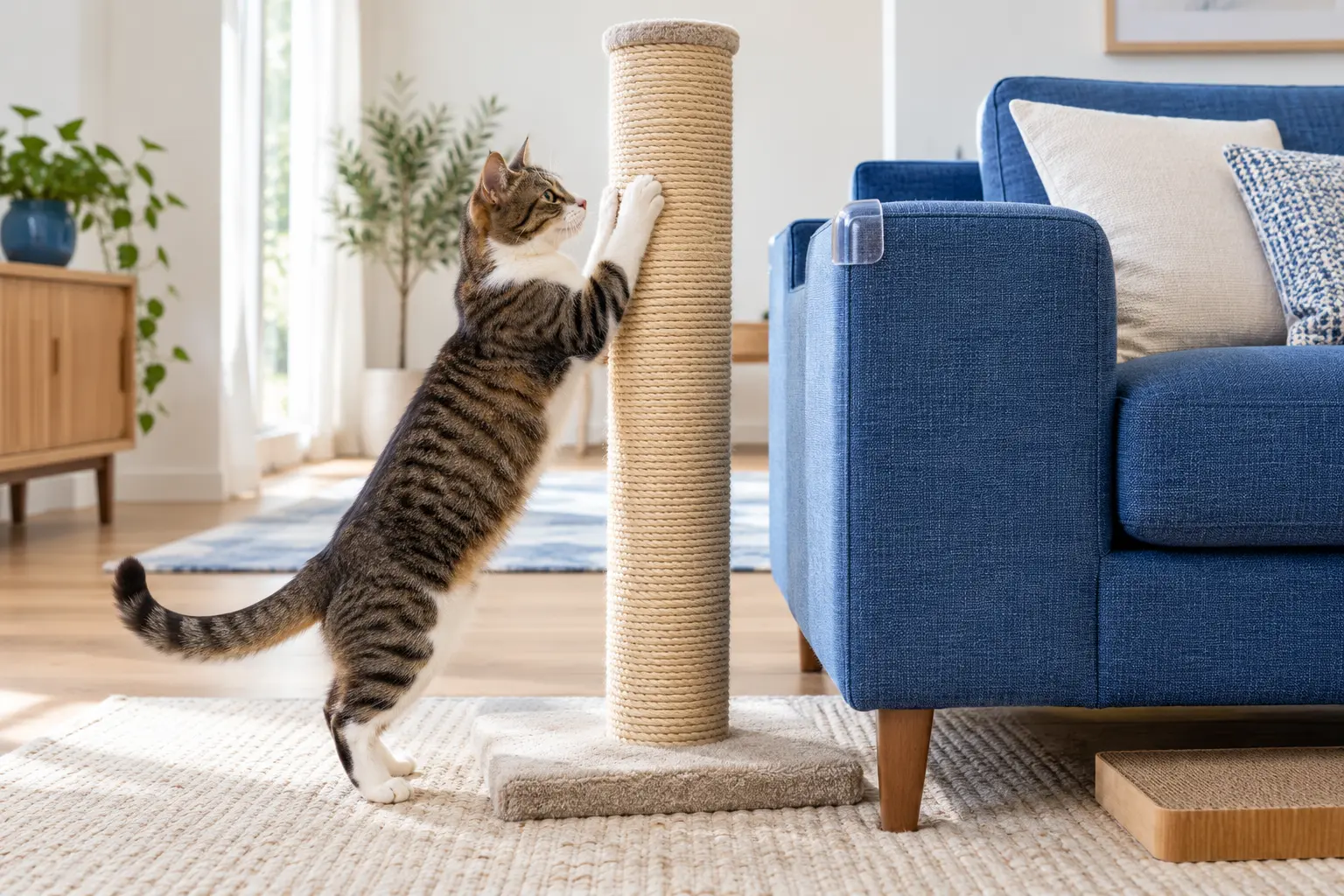
Keep it humane: Scratching is normal cat behavior. The ASPCA recommends offering appealing scratching surfaces instead of forcing a cat onto a post, and the organization's scratching guidance emphasizes stable posts and different orientations. Avoid punishment, frightening deterrents, sharp materials and declawing.
Why is the sofa more appealing than the current scratcher?
The sofa may offer the right location, height, resistance and texture all at once. A cat that stretches up an arm needs a different alternative from one that scratches a rug or the bottom edge. A hidden post across the room does not compete with a prominent corner on an everyday route.
Observe without interrupting. Note the exact panel, the direction of the paw movement, how high the marks reach and whether the sofa stays still under pressure. Also check whether the current scratcher wobbles or has a scratchable section shorter than the cat's reach.
Both the ASPCA and the German Animal Welfare Federation describe scratching as a natural behavior and recommend appropriate scratching opportunities. The German organization's cat-housing guidance lists scratching options among essential features of a cat-friendly home.
What should you measure before buying?
Use painter's tape on the floor—not the upholstery—to mark the proposed base. Check that people can pass safely and that the cat can approach, scratch and leave without being cornered.
Which products can redirect scratching and protect the sofa?
Tall vertical scratching post
Best for cats that stretch upward on a sofa arm or cornerA sturdy post placed directly beside the targeted sofa edge offers a similar upright movement on a surface designed for claws. The cat can stretch fully without the post leaning into the furniture.
- Benefits
- Matches upright scratching
- Supports a full-body stretch
- Easy to move next to the problem area
- Check before buying
- Compare usable scratching height with the cat's full standing stretch, not the overall product height. Check base width, weight, wobble, rope or fabric attachment and whether the post can sit flush beside the favorite corner.
- Possible drawback
- A short or light post may wobble, and a cat that prefers scratching flat surfaces may ignore it.
Horizontal scratching pad
Best for cats that scratch rugs, seat fronts or the floor near the sofaA flat cardboard, sisal or woven pad matches a low, forward scratching motion. It can be placed exactly where the cat plants its paws before reaching the upholstery.
- Benefits
- Matches floor-level scratching
- Usually compact and easy to replace
- Several textures are available
- Check before buying
- Choose a pad long and wide enough for the cat to stand on while scratching. Check material, loose particles, nonslip base, refill availability and whether the pad stays flat rather than curling at the edges.
- Possible drawback
- Cardboard can shed, and a light pad may slide unless it has enough weight or a suitable nonslip base.
Angled scratching board
Best for cats that prefer a sloped reach between flat and verticalAn angled board gives a different body position from a post or floor pad. It can fit beside a sofa end and help reveal whether the cat prefers incline, height or a particular texture.
- Benefits
- Offers a middle-ground scratching angle
- Can fit beside an arm or wall
- Often uses replaceable surfaces
- Check before buying
- Check the angle, usable length, base footprint and stability under forward pressure. A replaceable insert is useful, but it must lock into the frame without exposed clips or sharp edges.
- Possible drawback
- The frame takes more floor space than a flat pad, and a steep lightweight model can tip or slide.
Sofa-side scratching mat
Best for a cat strongly attached to one sofa arm or cornerA purpose-made mat wraps, hangs or stands against the targeted area, putting an acceptable scratching texture in almost the same location. It can preserve the familiar route while separating claws from the upholstery.
- Benefits
- Targets the established scratching spot
- Uses little extra floor area
- Can protect an arm while offering a scratch surface
- Check before buying
- Measure the full arm or corner, including curves and feet. Confirm the attachment method suits the sofa maker's guidance, does not block reclining parts and will not transfer dye, trap grit or place hard fasteners against the fabric.
- Possible drawback
- Fit varies widely, and a loose mat can shift, bunch or rub the upholstery it is meant to protect.
Removable sofa protector
Best for shielding the exact spot while a nearby scratcher is introducedA smooth clear panel, fitted arm cover or furniture-safe deterrent sheet can make the upholstery less satisfying for a limited period. It works best as a temporary barrier paired with an appealing scratcher beside it.
- Benefits
- Protects the current damage zone
- Keeps the sofa's shape visible
- Useful during a gradual redirection routine
- Check before buying
- Use only a product labeled for pets and the exact furniture surface. Test a hidden area and review adhesive, residue, finish, colorfastness, edge safety, removal method and compatibility with leather, coated or delicate fabric.
- Possible drawback
- Adhesive or rigid protectors can mark some finishes, look noticeable and fail if used without a better scratching option nearby.
ProblemPick compares product types, not current offers. Amazon shows products, prices, ratings, availability and seller terms only after you choose to open a link.
Quick comparison: which option fits the scratching pattern?
| Product type | Best use | Main limitation |
|---|---|---|
| Tall vertical scratching post | Best for cats that stretch upward on a sofa arm or corner | A short or light post may wobble, and a cat that prefers scratching flat surfaces may ignore it. |
| Horizontal scratching pad | Best for cats that scratch rugs, seat fronts or the floor near the sofa | Cardboard can shed, and a light pad may slide unless it has enough weight or a suitable nonslip base. |
| Angled scratching board | Best for cats that prefer a sloped reach between flat and vertical | The frame takes more floor space than a flat pad, and a steep lightweight model can tip or slide. |
| Sofa-side scratching mat | Best for a cat strongly attached to one sofa arm or corner | Fit varies widely, and a loose mat can shift, bunch or rub the upholstery it is meant to protect. |
| Removable sofa protector | Best for shielding the exact spot while a nearby scratcher is introduced | Adhesive or rigid protectors can mark some finishes, look noticeable and fail if used without a better scratching option nearby. |
Which option suits your cat and sofa?
Does the cat stretch upward along one sofa arm?
Put a tall, stable post beside that arm. The usable scratching section should cover the full reach, and the base should not wobble when pulled.
Are the lowest marks near the floor?
Try a wide horizontal pad directly in front of the spot. Choose enough length for the cat to stand on the pad while using it.
Does the cat alternate between low and upright scratching?
An angled board can test a middle position. If the preference remains mixed, use two simple surfaces rather than one elaborate structure.
Will a freestanding scratcher not fit beside the sofa?
A measured sofa-side scratching mat can follow the familiar location, but its backing and fasteners must suit the upholstery and stay secure.
Is the sofa already being damaged during the transition?
Protect that panel with a compatible removable guard while keeping the preferred scratcher immediately beside it. A barrier alone does not meet the scratching need.
How do you redirect sofa scratching without force?
If the sofa also collects fur, use the separate sofa pet-hair guide for material-safe cleaning. For odor rather than scratching, see how to address pet odor in a sofa. Browse more Pets and Home guides.
Sofa-scratching product buying checklist
Cat scratching and sofa FAQs
Why does my cat scratch the sofa even with a scratching post?
The post may be in the wrong place, too short, unstable or covered in a texture the cat does not prefer. Put a sturdy alternative directly beside the scratched area and match the cat's vertical, horizontal or angled movement.
Should a scratching post be taller than my cat?
It should provide enough usable scratching height for the cat to stretch upward comfortably without reaching the top or making the post wobble. Compare the cat's full standing stretch with the actual scratchable section.
Do clear sofa protectors work on every fabric?
No. Adhesives and rigid panels can react differently with woven fabric, leather, coatings and delicate finishes. Follow the furniture and protector instructions, then test a hidden area before wider use.
Is double-sided tape safe for a sofa and a cat?
Only use a purpose-made pet deterrent product that is labeled for the specific furniture surface, and follow its instructions. Do not improvise with construction, packing or other household adhesives.
How long should I keep the sofa protector in place?
Keep it only as long as needed to establish regular use of the nearby scratcher, checking the furniture and protector often. Remove or replace it according to the maker's directions if edges lift, residue appears or the cat chews it.
What should I avoid when redirecting sofa scratching?
Do not punish, frighten or physically force the cat onto a scratcher. Avoid unstable products, sharp fasteners and methods that suppress normal scratching without providing a suitable alternative.